I get emailed pictures of harnesses more than almost any other product category on this site – usually with a caption like “does this look right for her?” I understand the anxiety behind that question, because a dachshund’s equipment choices carry more weight than they do for most breeds. The wrong harness doesn’t just chafe or ride up; on a dog built the way ours are, it can genuinely contribute to the back injuries we spend so much time trying to prevent. So here’s the buying guide I wish I’d had when I started shopping for my own dachshund – what actually matters in a harness, which styles to avoid, and how to get a stubborn low-rider to accept wearing one in the first place.
If you haven’t already read my colleague Rex’s post on dachshund spinal health and IVDD prevention, that’s the foundation for everything below – it explains why this breed’s back is so vulnerable to begin with. This guide picks up from there and focuses specifically on the one piece of gear your dog wears every single walk.
Why a Harness Beats a Collar, Full Stop
For a dachshund, this isn’t really a debatable style choice the way it might be for a Labrador. Every ounce of leash tension on a collar transfers directly to the neck and, through the neck, into the upper spine and trachea. Dachshunds are already prone to tracheal collapse and cervical disc problems, and a collar concentrates exactly the kind of sudden, twisting force that makes both worse – the lunge at a squirrel, the surprised jerk backward from a delivery truck, the polite-but-firm correction when they refuse to move.
A well-fitted harness spreads that same force across the chest and shoulders instead, away from the neck and spine entirely. It also gives you actual control over a dog whose center of gravity is unusually low and whose pulling strength is disproportionate to their size – dachshunds were bred to dig into badger dens against resistance, and that stubborn, low-to-the-ground strength doesn’t disappear on a evening walk. If your dog is anything like most of the ones I hear from, a collar-only walk means you’re one hard pull away from a vet visit. A harness takes that risk off the table.
The Harness Styles That Actually Suit a Long Back
Not every harness style is created equal for this breed’s proportions. Here’s how the main types stack up:
Step-in harnesses are my default recommendation for most dachshunds. Your dog steps into two leg openings on the ground, you clip it up over the back, and there’s no wrestling a loop over their head – which matters more than it sounds like it should, because plenty of dachshunds genuinely hate anything passing near their face. Step-ins also tend to sit lower and shorter along the back than other styles, which suits a long spine better than a harness designed with a more standard body ratio in mind.
H-style (or Y-style) harnesses are the next best option and the one I’d point you to if your dog can’t tolerate the step-in motion. The straps form an H or Y shape across the chest and shoulders without a solid panel covering the sternum, which keeps the shoulder joints moving freely – important for a breed whose front assembly already does more work than most, given how much of their body weight sits forward.
Vest-style harnesses with a full fabric panel across the chest and back offer the most surface area to distribute pressure, which sounds like an advantage, but the tradeoff is heat and bulk on a dog whose belly is already close to the ground and prone to overheating in warm weather. I’d save these for cold-climate walks or dogs who need extra chest coverage for medical reasons, not as an everyday default.
What I’d actively steer you away from is anything with a single strap running straight across the front of the throat or a design that tightens further the more your dog pulls – sometimes marketed as a “no-pull” harness. Some no-pull designs work by cinching under the front legs when there’s tension, which can create its own chafing and restriction problems on a body already at a strange ratio of length to leg. If you need pulling help, look for a front-clip attachment point instead of a self-tightening mechanism – it redirects your dog toward you without adding pressure anywhere.
Getting the Sizing Right
Sizing a harness for a dachshund is different from sizing one for almost any other breed, because the standard size charts are built around dogs whose chest girth and body length are proportional. Ours aren’t. A dachshund can easily fall into a “small” category by weight and a “medium” by chest girth, and going strictly off breed-based size recommendations will get you a harness that’s either too tight around the ribs or long enough to slide side to side across the back.
Measure your own dog rather than trusting a size chart built for average proportions. You want the chest girth measured at the widest point just behind the front legs, plus the length from the base of the neck to where you want the rear strap to sit – usually just in front of the last rib, never so far back that it presses on the hips or interferes with hind-leg movement. Once the harness is on, you should be able to fit two fingers flat under any strap; snug enough that it can’t be backed out of, loose enough that it isn’t compressing anything.
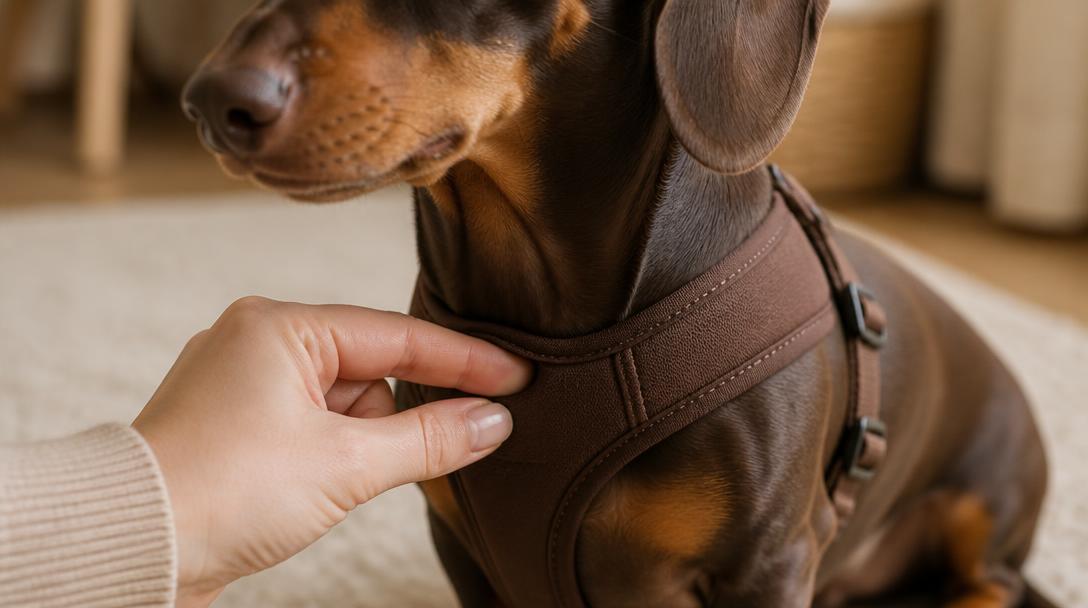
The two-finger test: snug enough to stay put, loose enough not to compress anything.
Escape-proofing matters more for this breed than most people expect. A dachshund’s chest is often narrower relative to their overall bulk than their handlers assume, and a startled backward wriggle can slip a loosely fitted harness right off. Look for a design with at least three points of adjustment – typically the neck, the girth, and sometimes the chest strap – so you can actually dial in a snug fit rather than choosing between “too loose” and “too tight.”
Features Worth Paying For
A few features are worth prioritizing once you’ve settled on a style:
- Padding along the spine strap – the piece running down the middle of the back is the one under the most direct pressure from leash tension and from your dog’s own pulling; a padded, wider strap here distributes that load far better than a thin nylon band.
- A sturdy front-clip ring in addition to the standard back clip – useful for redirecting a puller without any tightening mechanism, and handy for car safety clips too.
- Breathable mesh lining – a dachshund’s low-slung build means their underside runs warmer and picks up more ground heat than a taller dog’s, so airflow under any harness panel matters more here than it does for most breeds.
- Reflective stitching or piping – genuinely useful given how low to the ground and hard to spot a dachshund already is in low light, independent of any back-health benefit.
- Machine-washable materials – a low-rider’s harness collects more debris from brushing against grass, mud, and curbs than a harness worn by a dog who rides higher off the ground, so this isn’t a minor convenience feature for this breed.
Getting a Reluctant Dachshund to Accept a Harness
Plenty of dachshunds go stiff, flop over dramatically, or plant their feet the first few times a harness comes out, and that reaction is normal rather than a sign you’ve picked the wrong product. Introduce it slowly: let your dog sniff and investigate the harness with no expectation of putting it on, then reward calm curiosity with a treat. Once they’re relaxed around it, drape it over their back for a few seconds at a time, rewarding throughout, before ever attempting to fasten a buckle.
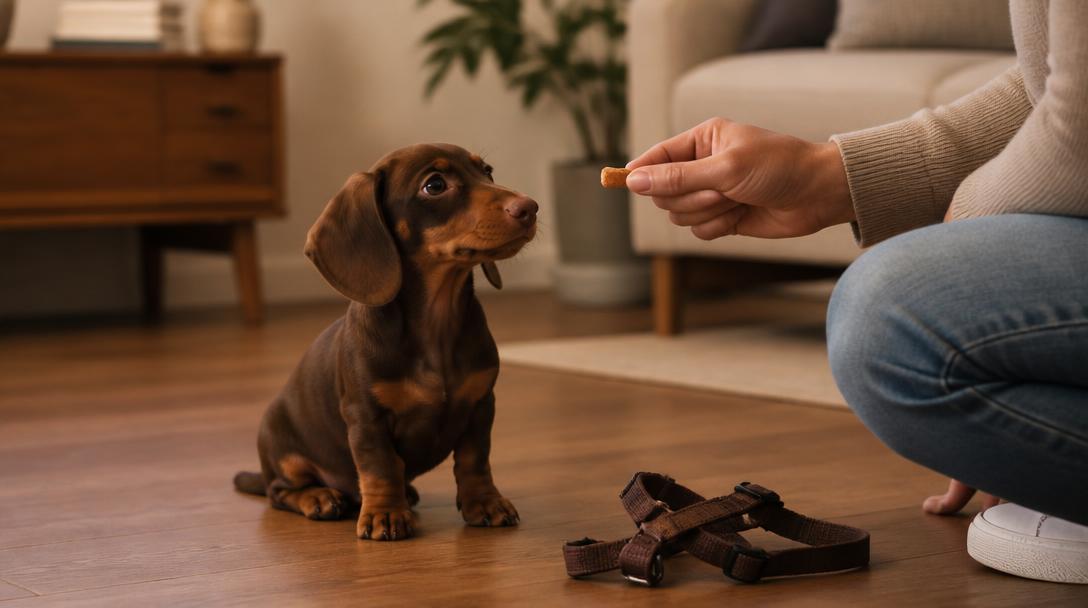
Let the harness predict good things before you ever fasten a buckle.
When you do fasten it, keep the first few sessions short and paired with something your dog already loves – a walk out the front door, a favorite toy, dinner. The goal is for the harness itself to predict good things rather than restriction. Most dachshunds come around within a week or two of short, low-pressure sessions; a dog who’s still fighting it after a month is often telling you something about the fit rather than the concept, so it’s worth re-checking the sizing before assuming your dog simply dislikes harnesses.
If your dog is recovering from a back injury or living with a diagnosed disc condition, loop your vet in before choosing a harness – some post-surgical or high-risk cases call for a specific support harness rather than a standard walking one, and that’s a conversation worth having directly with whoever is managing your dog’s care. For everyday exercise once your dog is cleared for it, my colleague Hank’s guide to safe exercise for dachshunds with back problems is a good next stop.
Frequently Asked Questions
Is a harness really necessary for a dachshund, or is a collar fine for identification tags only?
A collar with ID tags is fine to leave on at home, but walking on a collar puts direct pressure on the neck and trachea every time your dog pulls, lunges, or gets corrected. For actual walks, a properly fitted harness should be doing the work, with the collar reserved for holding tags.
How do I know if a harness is causing chafing I haven’t noticed?
Check under every strap after a walk, especially around the armpits and chest, for redness, flattened fur, or damp patches from friction. A harness that’s the right fit shouldn’t leave marks that are still visible twenty or thirty minutes after you take it off.
Should puppies wear a different harness than adult dachshunds?
Puppies need a harness sized for their current measurements, not room to grow into – a loose harness is an escape risk regardless of age, and most puppy harnesses are built with lighter materials and finer adjustment increments to match. Plan on resizing every few weeks during their first year rather than trying to buy one harness that lasts through a full growth spurt.
Can a harness alone prevent a back injury?
No single piece of gear eliminates the risk – a harness protects against leash-related neck and spine strain specifically, but jumping off furniture, rough play, and stairs are separate risk factors that need their own precautions, including the ramps and stairs covered in this buying guide.
The Bottom Line
A good harness is one of the cheapest, easiest back-health decisions you’ll make for your dachshund, and it’s one you get to make again every single day just by clipping it on before a walk. Prioritize a step-in or H-style design sized to your dog’s actual measurements, padded where the pressure concentrates, and free of any strap that runs across the throat or tightens under strain. Get the fit right, give your dog a little patience while they adjust, and you’ve taken one of the most common causes of preventable strain almost entirely off the table.