
I get asked more questions about ramps and stairs than almost any other product category on this site, and I understand why: once you know a dachshund’s spine is genuinely at risk every time they jump off a couch or leap out of the back seat, you can’t unknow it. A lot of owners come to me after a vet mentions IVDD for the first time, looking for something they can buy today that actually helps. So I put together the buying guide I wish existed when I started researching this for my own dog – what actually matters in a ramp or a set of stairs, how to tell a genuinely back-safe design from one that just looks the part in a product photo, and how to get a stubborn dachshund to actually use the thing once you own it.
If you haven’t read my colleague Rex’s post on dachshund spinal health and IVDD prevention, I’d start there for the full picture on why this breed’s back is so vulnerable in the first place. This post picks up where that one leaves off – it’s specifically about the gear that helps you manage the day-to-day jumping and climbing that puts a disc at risk.
Why Jumping Is Such a Big Deal for a Dachshund’s Back
Dachshunds are built with an unusually long spine relative to their leg length, a trait called chondrodystrophy that also causes their discs to degenerate and calcify earlier and faster than most other breeds. Somewhere between one in five and one in four dachshunds will experience a disc-related back injury at some point in their life – the highest rate of any breed. The mechanism that does the damage is almost always the same: a hard landing, a twisting jump, or repeated small-impact jolts that compress the spine over time.
The frustrating part is that most of those landings happen in completely ordinary moments – hopping off the couch to greet you at the door, jumping down from the bed after a nap, leaping out of the car before you’ve even opened the door all the way. None of it looks dangerous in the moment. It’s also almost entirely preventable with the right access points in place, which is exactly what a good ramp or staircase gives your dog.
Ramp or Stairs? How to Choose
This is the first fork in the road, and the honest answer is that it depends more on your dog’s personality and your furniture than on which option is objectively “better.” Both, done well, protect the spine equally.
Ramps tend to be the safer default for a true low-rider. There’s no repeated up-down motion through multiple joints, the incline is gradual, and most dachshunds pick up the gliding motion faster than a stepping motion. Ramps are also the only real option for tall SUVs or trucks, where stairs simply can’t bridge the height. The tradeoff is length – a properly gentle incline takes up real floor space, which matters if you’re working with a small bedroom or a couch tucked into a corner.
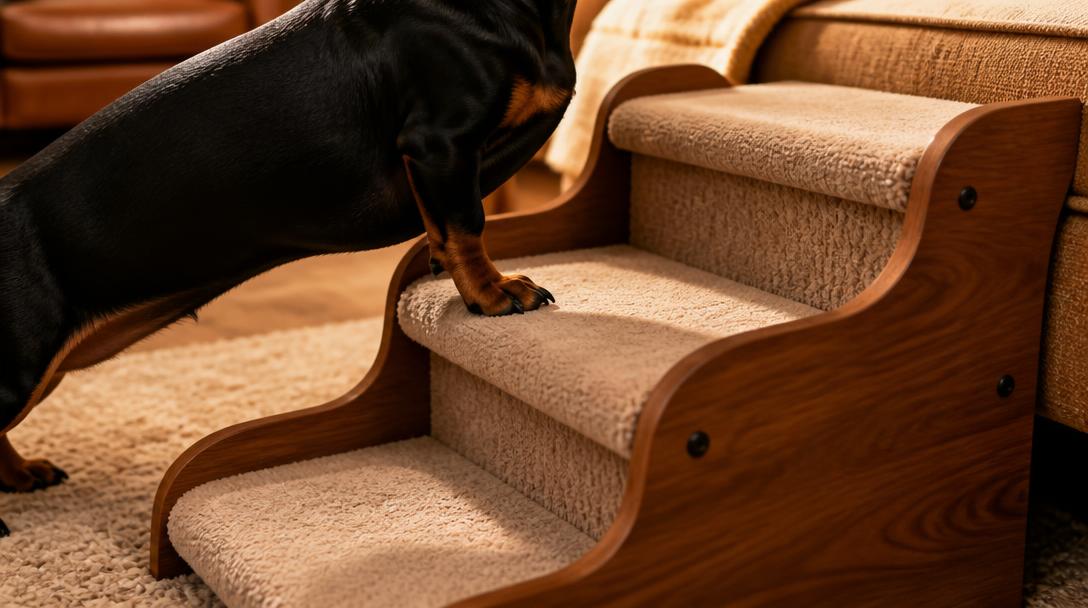
Stairs are more compact and often blend into a room better, especially the furniture-style sets designed to look like a small side table. They work well for dogs that are already confident climbers and for lower furniture where only two or three steps are needed. The risk with stairs is tread height – if the steps are too tall, you’ve essentially recreated a series of small jumps, which defeats the purpose entirely.
My rule of thumb: if the height you’re bridging is more than about 18 inches, or your dog is a puppy, senior, or already showing back sensitivity, go with a ramp. For shorter, more casual furniture and a confident adult dog, stairs are a fine choice.
What to Look for in a Dachshund Ramp
- Incline angle under 20–25 degrees. This is the single most important spec and the one most owners never check. A steep ramp puts nearly as much strain on the spine as a jump. As a rough guide, the ramp’s length should be roughly three to four times the height it’s bridging – a ramp reaching a 20-inch-tall bed should be at least 60 to 70 inches long.
- A non-slip surface with real texture. Carpeted ramps and ramps with molded traction grooves both work; smooth plastic or bare wood does not, especially once a paw is even slightly damp. Test this with your hand before you trust your dog on it.
- A weight capacity comfortably above your dog’s weight. Look for a stated capacity of at least 100–120 pounds even for a 20-pound dachshund – cheap ramps flex and bow under weight in a way that feels unstable to a nervous dog, which makes them refuse to use it.
- Raised side rails or edges. A dachshund’s narrow body means they can drift off the side of a flat ramp more easily than a broader-chested breed. Small raised lips along the edges add real security.
- Anti-slip or locking feet at the base. A ramp that shifts when your dog steps on it is a ramp that will get abandoned after one scare.
What to Look for in Dachshund Stairs
- Step height of 4–6 inches, no more. This is the dachshund-specific number that most general “dog stairs” products don’t account for – many are sized for taller breeds and end up too steep for a low-slung back.
- Deep, stable treads. Each step needs enough surface area for all four paws to land fully, not just the front two. Shallow treads encourage a hopping motion between steps rather than a controlled walk.
- A wide, stable base. Narrow or lightweight stair units can tip or slide, particularly on hardwood or tile. Look for a wide footprint and rubberized feet.
- Washable, grippy covers. Carpeted step covers help with traction but need to be removable for cleaning – a dachshund’s low body means they’ll shed on and rub against every step.
Bed, Couch, or Car: Match the Product to the Job
Not every ramp is built for every situation, and this is where a lot of owners end up with the wrong product.
Bed and couch ramps are usually foam-core or upholstered, lighter, and designed to be left in place permanently. Foam ramps also tend to be quieter, which matters for dogs who startle at the hollow thud of a hard plastic ramp.
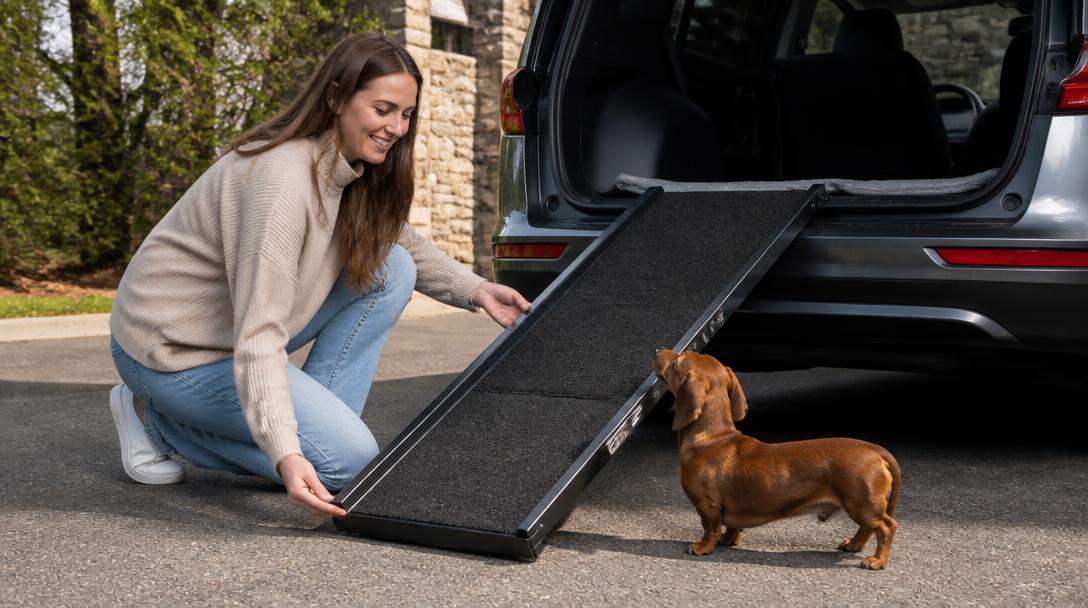
Car and SUV ramps need to be a completely different category of product – foldable, rigid rather than foam (foam compresses too much under the sharper angle a vehicle requires), and rated for outdoor use if you’ll be using them on driveways or at trailheads. A car ramp also needs a non-slip surface that still grips when wet, since it’s the one ramp that regularly gets used in rain or snow. If your dachshund also rides in the car regularly, it’s worth reading through our guide on dachshund car seats alongside this one – a secured car seat and a proper loading ramp solve two different halves of the same back-safety problem.
Bathtub or sink steps are a smaller but genuinely useful category, especially if you’re following back-safe lifting technique for bath time. A short two-step unit lets your dog walk into a raised tub instead of being lifted the whole way, which reduces strain on both of you.
Teaching Your Dachshund to Actually Use It
Here’s the part nobody warns you about: buying the ramp is the easy step. Plenty of dachshunds take one look at a new ramp and simply walk around it, jump past it, or refuse to set a paw on it for days. That’s completely normal and not a sign you bought the wrong thing.
- Start at floor level. Before asking your dog to climb anything, let them walk across the ramp laid flat on the floor so the texture and sound become familiar.
- Use high-value treats and a slow lure. Place a treat just past the base of the ramp, then a few inches up, gradually working your way to the top over several short sessions rather than one long one.
- Block the jump, don’t just offer the ramp. Dogs are creatures of habit – if jumping is still physically possible, most will default to the shortcut. A cushion or exercise pen along the open side of the bed or couch removes that option while the ramp habit forms.
- Never force or carry them onto it. Fear of the ramp itself, once established, is much harder to undo than a slow week of positive introduction.
- Expect one to two weeks of consistency. Most dachshunds fully adopt a ramp within this window if the jump-shortcut is genuinely blocked and the introduction stays positive.
Mistakes That Waste Your Money
The return pile for dog ramps is full of the same few mistakes. A ramp that’s too short for the height it’s bridging creates too steep an angle no matter how good the materials are – always measure your furniture height before you buy, not after. A ramp or stair set that wobbles even slightly during a quick in-store or return-window test will get rejected by a cautious dog within the first few uses. And buying based on how a product looks in a room rather than its stated weight capacity and incline angle is the single most common regret owners mention to me – a ramp that matches your decor but flexes under 25 pounds isn’t doing its job.
If your dachshund is already showing signs of back pain – reluctance to jump, a hunched posture, yelping when picked up, or dragging a hind leg – a ramp is not a substitute for a vet visit. Treat new or worsening symptoms as urgent, and use gear like this as prevention once your dog has been cleared, not as a first response to an active injury.
Frequently Asked Questions
Do dachshunds actually need a ramp, or is this overkill?
Given how common IVDD is in this breed – roughly one in four dachshunds will have a disc injury in their lifetime – a ramp for their main jumping spots (bed, couch, car) is one of the cheapest, easiest prevention steps you can take. It’s not overkill; it’s one of the few back-health measures that’s entirely within your control.
What incline angle is actually safe for a dachshund ramp?
Aim for 20 to 25 degrees or shallower. As a simple check, the ramp’s length should be roughly three to four times the height it needs to reach.
My dachshund refuses to use the ramp I bought. What now?
Go back to basics: let them explore it flat on the floor first, use treats to lure them up gradually over several short sessions, and block the jump they’d otherwise take as a shortcut. Most dogs come around within one to two weeks with consistent, low-pressure practice.
Are foldable ramps sturdy enough for daily use?
Good ones are – look for a stated weight capacity well above your dog’s actual weight and check that the folding hinge locks securely rather than just resting closed. Foldable ramps are genuinely useful for car access since they need to travel with you, but for a permanent bed or couch ramp, a solid, non-folding design is often more stable.
Can puppies use ramps, or should I wait until they’re older?
Puppies can and should start using ramps early, since good habits formed young tend to stick. Just make sure the ramp itself is sized appropriately – a very young or small puppy may need a gentler incline than an adult dachshund would.
Bringing It All Together
None of this needs to be complicated. Pick a ramp for anything higher than about 18 inches, keep the incline gentle, check that it’s genuinely stable before trusting your dog on it, and be patient during the training-in period. It’s a small investment next to what an IVDD diagnosis and recovery actually costs – both financially and in terms of your dog’s comfort – and it’s one of the few pieces of dachshund gear that does exactly what it promises. If you want the fuller picture on protecting your dog’s back day to day, my colleague Rex’s guide to senior dachshund care covers home modifications like these in more depth, especially for older dogs whose spines need extra consideration.