
I get asked about dog strollers more than almost any other product category, and I used to be a little skeptical myself — a stroller for a dog who can walk sounds like something you’d buy for show, not function. Then I started fielding questions from owners whose dachshunds were recovering from IVDD surgery, or whose seniors simply couldn’t manage the distances they used to, and I changed my mind completely. For this breed in particular, a good stroller isn’t a vanity purchase. It’s a mobility tool that lets a dog with a vulnerable back keep getting fresh air, sunshine, and time outside without the jostling, jumping, or overexertion that could set back a recovery or strain an already-compromised spine.
This guide walks through when a stroller actually makes sense for a dachshund, the types available, and — most importantly — the specific features that matter for a breed built the way ours is. I’m not going to point you at one “best” model, because the right stroller depends heavily on your dog’s size, your terrain, and your budget. Instead, I’ll give you what to actually look for so you can shop with confidence.
Why a Stroller Can Be a Real Tool for Dachshunds, Not Just a Luxury
Dachshunds are built with an unusually long spine relative to their leg length, which is exactly what makes them so prone to intervertebral disc disease (IVDD) and other back problems. Anything that reduces jarring impact, sudden jumps, or overexertion on that spine is working in your dog’s favor. A stroller does all three: it keeps a dog off pavement that’s absorbing every footstep, it removes the temptation to leap toward another dog or a squirrel, and it lets you control exactly how much walking happens versus how much riding happens.
That doesn’t mean every dachshund needs one. A healthy adult dog with no back history is usually better served by regular walks that build muscle and cardiovascular fitness. But there’s a meaningful group of dachshunds for whom a stroller genuinely changes quality of life.
When a Stroller Makes Sense for Your Dachshund
A few situations come up again and again with the dachshund owners I talk to:
- Post-surgical recovery. A dachshund recovering from IVDD surgery typically needs weeks of strict activity restriction before they’re cleared for normal walks again. A stroller lets you get them outside for mental stimulation and a change of scenery without risking the healing disc space. (If you’re in this stage right now, our guide to IVDD recovery after surgery covers the full timeline and what’s safe at each stage.)
- Senior mobility decline. Arthritis, weakening hind legs, or simple age-related stamina loss can shrink a senior dachshund’s comfortable walking distance to a fraction of what it used to be. A stroller lets them join the family on a longer walk or a neighborhood outing without pushing past what their body can handle.
- Heat and hot pavement. Dachshunds sit low to the ground, which means hot asphalt and concrete affect them more directly than it does a taller breed. A stroller keeps paws off scorching surfaces during warmer months.
- Reactive or anxious dogs in crowded spaces. Busy sidewalks, farmers markets, or outdoor events can overwhelm a small, low dog surrounded by bigger ones. A stroller gives a nervous dachshund a safe, elevated vantage point.
- Multi-dog households with mismatched pace. If you’re walking a dachshund alongside a larger, faster dog, a stroller lets the smaller one come along without being dragged or left behind.
Types of Dog Strollers to Consider
Dog strollers generally fall into a few categories, and dachshunds can usually use any of them — the deciding factor is more about your lifestyle than the breed itself.
Three-wheel (jogging-style) strollers
These have a single front wheel and two rear wheels, similar to a jogging stroller for a baby. They handle well on uneven terrain like gravel paths or grass, and the single front wheel makes tight turns easier. They tend to be a bit larger overall, so check folded dimensions if storage space is tight.
Four-wheel standard strollers
The classic pram-style design with four wheels is the most stable option and usually the easiest to push in a straight line on smooth sidewalks. Many fold flatter than three-wheel models, which matters if you’re storing it in a car trunk or an apartment closet.
Stroller and car seat combos
Some models double as a car safety seat that clips in and out of a wheeled base, similar to an infant travel system. These are worth considering if your dachshund already travels in the car often, since it cuts down on transferring the dog between carriers.
Key Features That Matter for a Dachshund Specifically
This is the part most general “best dog stroller” roundups skip, because they’re not written with a long-backed, short-legged breed in mind. A few features matter more for dachshunds than they would for a typical medium-sized dog.
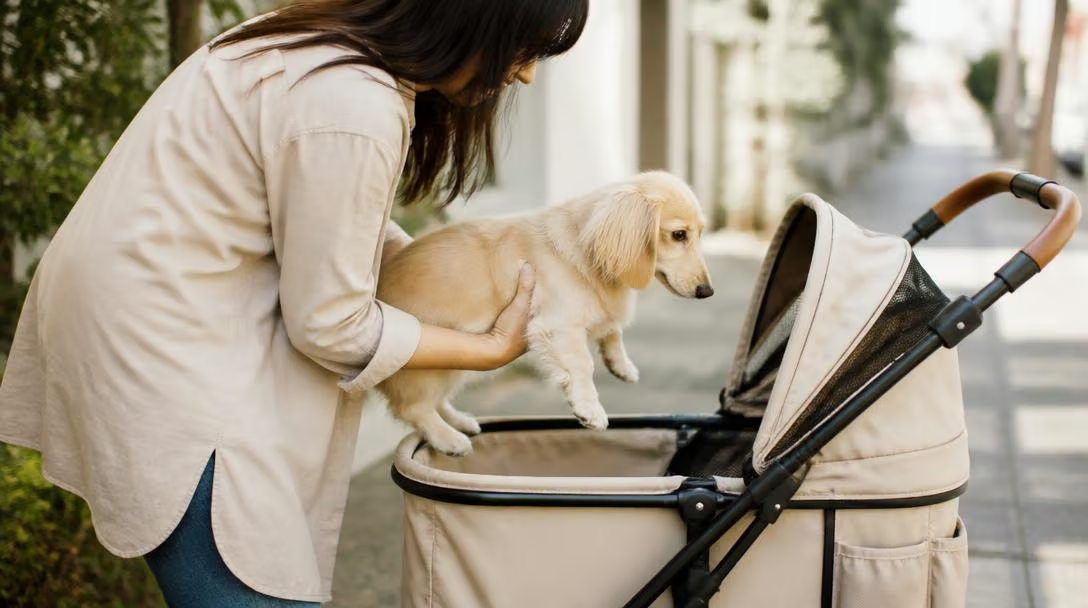
- Low step-in height or a ramp-style entry. A dachshund should never jump in or out of a stroller — that’s exactly the kind of impact their back doesn’t need. Look for a low entry point, and plan to lift your dog in and out yourself, supporting their chest and hindquarters rather than letting them climb.
- A secure internal tether or harness clip. Every stroller worth buying has a built-in leash clip or tether inside the carrying compartment. This is non-negotiable for a dachshund — you don’t want a dog jumping out mid-walk, especially one who’s recovering from a back injury or getting up in years and unsteady.
- Compact, lightweight frame. Dachshunds are small dogs, so you don’t need a stroller rated for a 50-pound dog. A compact frame designed for small breeds (generally under 25–30 lbs) will be easier to maneuver, store, and lift in and out of a car.
- A smooth, stable ride. Look for decent suspension or at least solid, well-inflated or foam-filled tires. A dog recovering from spinal surgery doesn’t need every crack in the sidewalk transmitted straight through a stiff, bouncy frame.
- Full enclosure with mesh ventilation. A zip-up or snap-on mesh cover keeps your dog from trying to climb out and lets you walk through areas with other dogs without worry, while still allowing airflow so it doesn’t feel stuffy underneath.
- Weather protection. A removable rain/wind cover and a retractable canopy extend how often you can realistically use the stroller through the year, which matters a lot in a climate with real winters.
How to Introduce Your Dachshund to a Stroller
Most dachshunds take to a stroller faster than owners expect, but a few short, positive introduction sessions make a real difference — especially for a dog who’s never ridden in one before.
- Let your dog sniff and explore the stationary stroller indoors first, with treats scattered inside the compartment.
- Lift them in gently (never let them jump), clip the internal tether, and let them sit for a minute or two without moving the stroller at all.
- Push it a few feet around a quiet room before ever taking it outside.
- Keep the first few real outings short — five to ten minutes — and build up gradually.
- Bring a favorite toy or blanket for the first several rides so the space feels familiar.
A dog who’s anxious or resistant at first almost always settles in within a handful of short sessions. Forcing it or scolding a reluctant dog tends to backfire — patience here pays off quickly.
Safety Tips for Stroller Walks
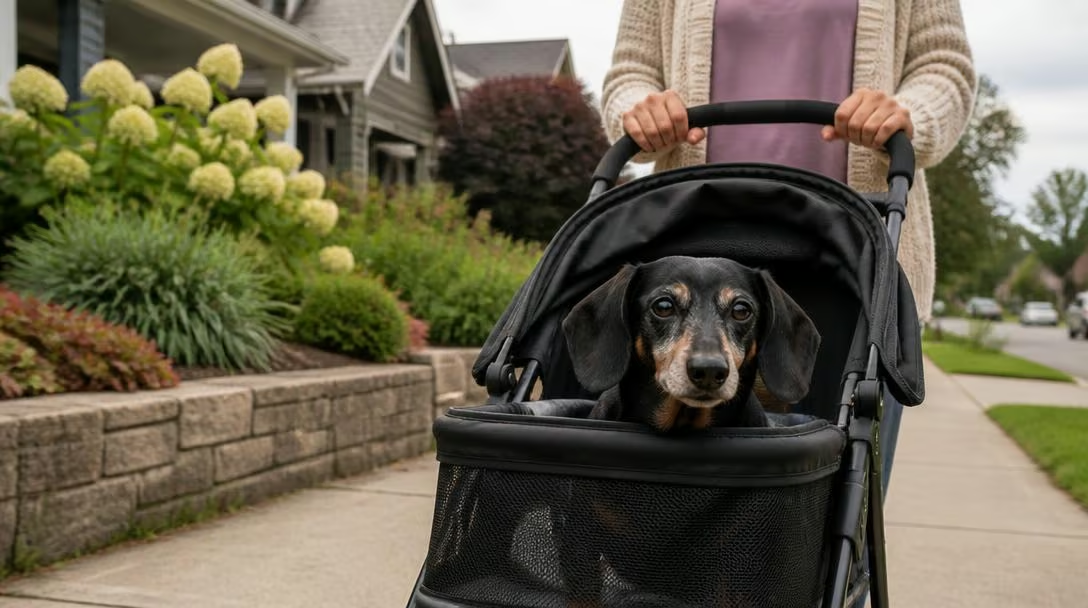
A stroller is only as safe as how it’s used. Keep these habits in mind every time you head out:
- Always clip the internal tether, even for short trips — dogs can and do try to jump out when something exciting catches their attention.
- Never leave your dog unattended in the stroller, even for a quick errand stop.
- Lift your dog in and out every time rather than letting them climb, no matter how capable they seem on a given day.
- Check the temperature inside an enclosed canopy on warm days — mesh ventilation helps, but direct sun on a covered stroller can trap heat quickly.
- Lock the wheels when stopped on any kind of slope, just as you would with a baby stroller.
Stroller vs. Other Mobility Options
A stroller isn’t the only tool in the mobility toolbox, and it’s worth knowing where it fits relative to the alternatives. Simple carrying works fine for very short distances but isn’t practical for a full walk and puts strain on your own back and arms. A pet wagon offers similar benefits to a stroller — smooth ride, no jumping required — but typically has a higher side wall that’s harder for an owner to lift a dog over repeatedly. A wheelchair or cart, by contrast, is a different category entirely: it’s for dogs with permanent or long-term hind-limb weakness who still want to use their front legs to move under their own power, rather than ride passively. If your dachshund is in the acute recovery window after IVDD surgery, a stroller is almost always the better choice for getting outside safely; a cart typically comes into the picture later, if at all, and only for dogs with lasting mobility loss. For home-based mobility support in the meantime — getting on and off furniture, navigating stairs — our guide to senior dachshund home safety covers ramps and traction fixes that pair well with stroller use outdoors.
Frequently Asked Questions
Is it bad to let my dachshund walk instead of using the stroller at all?
Not at all — for a healthy dachshund with no back history, regular walking is genuinely good for them and helps maintain the core and back muscle that protects their spine. A stroller is meant to supplement or replace walking in specific situations (recovery, senior decline, heat, crowds), not to eliminate walking as a default.
What size stroller does a dachshund actually need?
Most dachshunds, including standard-sized ones, fit comfortably in strollers designed for small breeds up to roughly 25 pounds. Measure your dog’s length and height before buying, since a dachshund’s long body shape means some compact “teacup” strollers may feel cramped even though the dog’s weight fits the stated limit.
Can I use a stroller during IVDD recovery, or does my dog need to stay fully confined?
This depends entirely on where your dog is in the recovery timeline, and you should follow your veterinarian’s specific restrictions rather than a general rule. Many vets do approve supervised, tethered stroller outings once the strictest crate-rest period has passed, as a way to provide mental stimulation without physical strain — but always confirm timing with your vet first.
How do I clean a stroller after muddy walks or an accident inside it?
Most stroller fabric liners are removable and machine-washable on a gentle cycle — check the specific product’s care instructions. For the frame and wheels, a damp cloth and mild soap handle most everyday grime, and letting the fabric fully air dry before reassembling helps prevent odor.
Giving Your Dachshund the Outside Time They Deserve
A stroller won’t replace everything a good walk does for a dachshund, and it isn’t the right tool for every dog or every stage of life. But for a recovering back, an aging body, or simply a hot afternoon on scorching pavement, it can be the difference between a dog who gets left at home and one who gets to come along. Look for the features that matter most for this breed specifically — a low, lift-in entry, a secure internal tether, and a smooth, stable ride — and you’ll end up with something your dachshund genuinely enjoys using, not just a product gathering dust in the garage.


