
Every so often someone emails me a photo of their dachshund and asks, “Is this a rabbit dachshund, or did my mini just stay small?” It’s a fair question, and the honest answer is that most people — including a lot of longtime dachshund owners — have never heard the real definition. “Rabbit dachshund” isn’t a cute nickname for an especially tiny mini. It’s an official, measurable size category in much of the world, and understanding how it actually works will save you from a lot of bad information floating around online.
I’ve owned dachshunds of two different sizes myself, and I’ve spent a fair amount of time talking with breeders about how sizing actually gets decided. So let’s clear up what “rabbit” and “Kaninchen” really mean, how the size is measured, and — just as important — what to watch out for if you’re thinking about adding one of these pint-sized dachshunds to your family.
What Does “Rabbit” or “Kaninchen” Actually Mean?
“Kaninchen” is simply the German word for “rabbit.” Dachshunds were bred in Germany for underground work — badgers were the headline job, but smaller dachshunds were also put to work on rabbits, rodents, and other burrowing game that a standard-sized dog was too big to follow into a tunnel. The name reflects that smaller job description and the rabbit-sized build it required, rather than referring to any particular rabbit-hunting technique you’d recognize today.
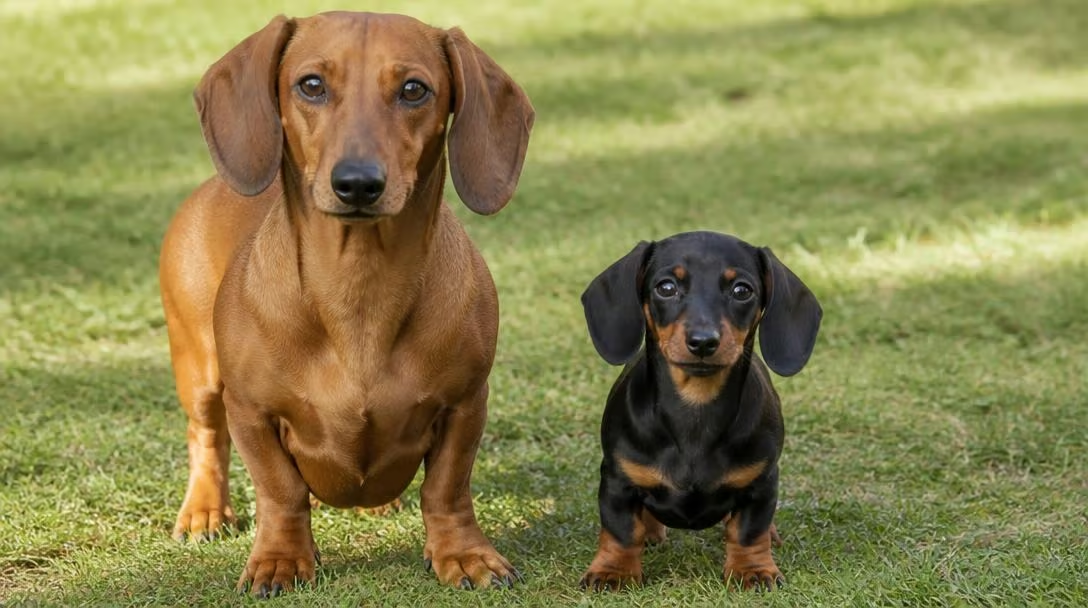
Here’s the part most people get wrong: a “rabbit dachshund” isn’t just a miniature dachshund that happens to be on the smaller end. It’s the third, smallest rung on an official three-tier size ladder used by European and international kennel clubs. In other words, there isn’t just “standard” and “mini” — there’s a whole additional category below mini that most American owners have simply never encountered.
The Three Official Dachshund Sizes
Under the Fédération Cynologique Internationale (FCI) breed standard, which most of Europe and much of the rest of the world follows, dachshunds come in three recognized sizes: Standard, Miniature (sometimes called Zwerg), and Kaninchen, or rabbit. The size categories aren’t decided by a glance, a bathroom scale, or a height chart — they’re defined by chest circumference, measured on a fully mature dog at a minimum of 15 months old.
That detail matters more than it sounds like it should. A dachshund puppy’s chest keeps growing well past the point where its legs and body length stop changing much, so measuring a young dog tells you almost nothing reliable about its adult size category. Breeders who know what they’re doing wait until that 15-month mark specifically because measuring earlier can misclassify the dog entirely.
Roughly speaking, standard dachshunds measure above about 35 centimeters of chest circumference, miniatures fall in the 30–35 centimeter range, and Kaninchen dachshunds come in under 30 centimeters. Weight and height are sometimes used as rough, informal shorthand — Kaninchen dachshunds often land somewhere around 8 to 10 pounds fully grown, noticeably lighter than a standard dachshund’s 16-to-32-pound range — but weight was never the official measurement, and you’ll find it quoted inconsistently from one source to another. Chest circumference is the method that actually counts.
Why Americans Rarely Hear About This Size
If you’ve only ever shopped for a dachshund in the United States, there’s a good reason “rabbit dachshund” sounds unfamiliar: the American Kennel Club officially recognizes only two sizes — standard and miniature. The AKC’s miniature cutoff is a dog under 11 pounds at 12 months of age, full stop. There’s no third, smaller official tier in the AKC system the way there is under the FCI.
That doesn’t mean small Kaninchen-sized dachshunds don’t exist in North America — plenty of miniature dachshund litters naturally produce puppies that would qualify as Kaninchen-sized under the FCI scale. It just means there’s no separate American category or paperwork for it. If a breeder in the US advertises “rabbit dachshund puppies,” they’re using a European term informally, not registering the dog under a recognized third size. If you’re trying to understand sizing within the categories the AKC does recognize, our complete guide to the standard dachshund is a good place to start, and our miniature dachshund guide covers the size most American “rabbit” dachshunds actually fall under on paper.
How to Tell If a Dachshund Is Rabbit-Sized
If you already have a dachshund and you’re curious where they’d land on the FCI scale, the only reliable way to know is a proper chest measurement taken after 15 months of age — not a guess based on how small they look standing next to a neighbor’s lab. A flexible measuring tape wrapped around the widest point of the chest, just behind the front legs, is the standard approach breeders use.
If you’re shopping for a puppy and a breeder is specifically marketing “rabbit” or “Kaninchen” dachshunds, ask how they’re determining that classification. A responsible breeder will talk about the parents’ measured sizes and the typical range their lines produce — not just “they’re the runt of the litter” or “they stayed small.” Puppy size at eight weeks is a notoriously unreliable predictor of adult size in this breed, and anyone promising a guaranteed tiny adult from a young puppy is making a claim they can’t actually back up yet.
Temperament: Is a Kaninchen Dachshund Different?
Here’s some good news: size doesn’t change the dog underneath. A Kaninchen dachshund has the same bold, curious, stubborn-in-a-charming-way personality that makes the breed what it is, regardless of whether it measures 28 centimeters or 38. They’re still bred from working stock with a strong prey drive, a loud bark for their size, and a deep attachment to their people. If you’re drawn to the dachshund personality, downsizing to a rabbit-sized dog won’t give you a meaningfully different temperament — just a smaller package carrying the same big personality.
The Health Side: Why Size Matters More Than Cuteness
This is the part I think doesn’t get said often enough. Dachshunds as a breed already carry an elevated risk of intervertebral disc disease (IVDD) because of their long spine and short legs — it’s a structural trade-off baked into the body type we all love. Breeding deliberately toward the smallest possible end of the size range, especially chasing “teacup” extremes beyond even the Kaninchen standard, can make that underlying skeletal fragility worse, not better. Very small dogs are also more prone to hypoglycemia, dental crowding, and a shorter margin for error with injuries from everyday jumps and falls that a larger dog would shrug off.

None of that means a properly bred Kaninchen dachshund is unhealthy — plenty of them live full, happy lives. The distinction I want to draw is between a breeder who’s producing Kaninchen-sized dogs because that’s where their lines naturally and healthily fall within the standard, versus a breeder marketing “extra tiny” or “teacup” dachshunds as a novelty selling point. The second group is optimizing for smallness itself, which is exactly the kind of breeding decision that tends to compound this breed’s existing back and joint vulnerabilities. If you want a dachshund of any size, ask breeders directly about the health testing and size history of their lines, and be skeptical of anyone treating extreme smallness as the main selling point.
Is a Rabbit Dachshund Right for You?
A Kaninchen-sized dachshund can be a wonderful fit if you want all the classic dachshund traits in the smallest practical package — they’re easier to lift, take up less space, and are just as portable as a mini for travel or apartment living. But they come with the same long-back vulnerability as every other dachshund size, so the daily precautions — no unsupervised stairs, no jumping off furniture, careful lifting technique — matter just as much, arguably more, given how little margin a very small frame has for injury.
If you’re set on finding one, look for breeders who are transparent about measured parent sizes, health testing, and realistic adult-size expectations rather than guaranteed “teacup” promises. And if your heart’s set on the smallest dachshund you can responsibly find, remember that a dog that’s a touch bigger than the absolute minimum Kaninchen range is still going to be a wonderfully tiny, big-hearted companion.
Frequently Asked Questions
Is a rabbit dachshund a separate breed?
No. Standard, miniature, and Kaninchen are all the same breed, Dachshund — they’re size variants within the breed, not separate breeds, defined by chest circumference rather than genetics or appearance beyond scale.
Does the AKC recognize rabbit dachshunds?
No. The AKC recognizes only standard and miniature sizes. “Rabbit” or “Kaninchen” is an FCI (international) classification used mainly in Europe, so a US-bred “rabbit dachshund” is being described informally rather than registered under a third official size.
How small is a Kaninchen dachshund, exactly?
Officially, it’s defined by chest circumference under about 30 centimeters, measured at 15 months or older — not by weight. As a rough, informal guide, Kaninchen dachshunds often weigh somewhere around 8 to 10 pounds as adults, but that figure varies and isn’t the official measurement.
Are rabbit dachshunds less healthy than standard dachshunds?
Not inherently — a responsibly bred Kaninchen dachshund that falls naturally within the standard can be just as healthy as any other dachshund. The real risk comes from breeding specifically for extreme smallness beyond the standard, which can worsen the breed’s existing back and joint vulnerabilities.
The Bottom Line
“Rabbit dachshund” isn’t marketing fluff — it’s a real, measurable size category most American owners simply haven’t encountered because our kennel club doesn’t use it. Now that you know what Kaninchen actually means and how it’s measured, you’re in a much better position to ask breeders the right questions, whatever size dachshund ends up stealing your heart.


