
Nail trims are the grooming task I get the most anxious messages about — more than baths, more than ear cleaning, more than shedding. I understand why. A wriggly, low-to-the-ground dog and a sharp clipper feel like a bad combination, and most owners have either a bad memory of cutting the quick once or a dog who’s decided the whole event is a personal betrayal. But overgrown nails are a real health problem in this breed, not just a cosmetic one, and once you understand the anatomy and have the right tools, it’s a five-minute job you can do calmly at home.
I’m Rex, and healthcare is my corner of this site. So let’s get past the fear and talk about why nail length matters so much for a dachshund specifically, how to do the trim itself without a wrestling match, and what to do if things don’t go perfectly.
Why Nail Length Matters More Than Most Owners Realize
For a lot of breeds, long nails are mostly a comfort issue. For a dachshund, they’re a structural one. This is a dog built low, long, and stretched over a spine that’s already working harder than it should against gravity. When nails get too long, they hit the ground before the paw pad does, which pushes the toes back and forces the foot to splay slightly with every step. Over months, that changes how weight travels up through the leg — and eventually up through the back.
I’ve written before about how much a dachshund’s joints and posture matter to long-term spinal health, and nail length is one of the more overlooked pieces of that picture. A dog compensating for long nails is a dog subtly changing its gait, and a breed already at elevated risk for disc disease doesn’t have much margin for extra strain. This isn’t a reason to panic over a slightly-too-long nail — it’s a reason to treat trims as routine maintenance rather than an occasional emergency.
Understanding the Quick — Why the Fear Exists in the First Place
Almost every hesitant owner I talk to is really afraid of one specific thing: hitting the quick. The quick is the blood vessel and nerve bundle that runs through the center of the nail. Cut into it and you’ll get a yelp, a few drops of blood, and a dog who trusts you slightly less for the next trim. It’s not dangerous, but it’s unpleasant for everyone involved, and it’s the single biggest reason people avoid trimming altogether — which, ironically, makes the problem worse, because nails that are never trimmed cause the quick itself to grow longer over time, shrinking your safe margin even further.
Here’s the part that actually solves the fear: on a dachshund with white or light-colored nails, you can usually see the quick directly. It shows up as a pink or reddish core running through the center of the nail, visible if you look at the nail from underneath with decent light. You simply trim up to where that pink area begins and stop.
Black nails are the harder case, since the quick isn’t visible from the outside. Many dachshunds have a mix of both on the same paw, which is actually useful — you can use the light nails as a rough guide for how far the quick tends to extend on that individual dog. For black nails, the safest approach is to trim in small increments rather than one confident cut. Take a thin slice off the tip, look at the cut surface, and stop as soon as you see a small dark or grayish dot appear in the center — that’s the quick coming into view, and it’s your signal to leave the rest alone.
Tools Worth Having Before You Start
The right tool makes a bigger difference here than most owners expect. A few options:
- Guillotine-style clippers — the nail goes through a hole and a blade slices upward. These give a clean, single cut and work well for most dachshund nails, though they can be awkward on very small or very thick nails.
- Scissor-style (plier) clippers — these work more like a strong pair of scissors and give you better visibility of the nail as you cut, which some owners find less intimidating than the guillotine style.
- A nail grinder (rotary tool) — instead of cutting, this gradually files the nail down. It takes longer per nail but removes the “one wrong cut” risk almost entirely, since you can stop the moment the nail feels warm or you see the quick approaching. It’s a good option for a nervous dog or a nervous owner.
- Styptic powder — keep this on hand every time, even if you never end up needing it. If you do nick the quick, pressing a pinch of styptic powder onto the tip stops the bleeding in under a minute. Cornstarch works in a pinch if you’re caught without it.
How to Trim Your Dachshund’s Nails, Step by Step
Once you’ve got a tool you’re comfortable with, the process itself is straightforward:
- Pick a calm moment. After a walk or play session, when your dog is a little tired, tends to go much better than first thing in the morning when energy is high.
- Get a good grip on the paw. Hold the paw gently but securely, with your thumb on the pad and a finger on top of the toe you’re working on, so the nail is stable and you can see it clearly.
- Identify the quick first, every single nail. Don’t assume all four paws or all five nails on a paw are the same — the dewclaw (if present) especially tends to be shorter and curved, and it’s easy to misjudge.
- Cut at a slight angle, following the natural curve of the nail, roughly parallel to how the quick tapers, rather than straight across.
- Take small amounts on dark nails rather than guessing at one bigger cut, checking the cut surface after each slice.
- Smooth sharp edges afterward with a nail file if you have one — this also softens any slightly-too-close cuts.
- Reward generously after each paw, not just at the end. Splitting the reward across the session keeps a nervous dog more engaged and makes the next trim easier.
Desensitizing a Nervous or Difficult Dachshund
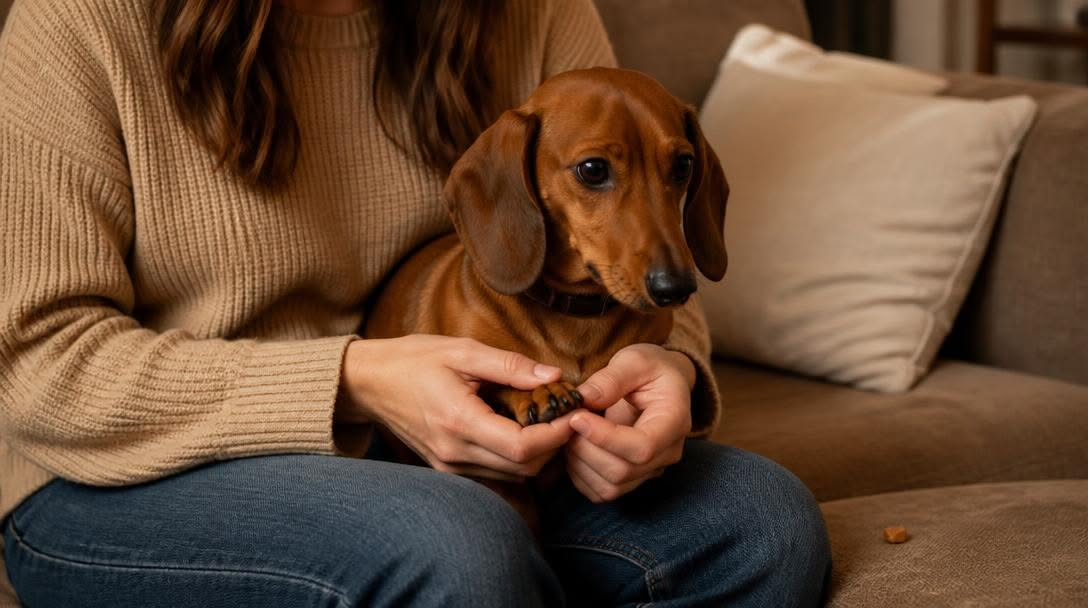
Dachshunds have a well-earned reputation for being vocal, stubborn, and occasionally dramatic about nail trims specifically, even ones who are relaxed about everything else. If your dog has already decided nail trims are a crisis, don’t try to push through a full trim in one sitting — that usually cements the fear rather than fixing it.
Instead, spend a few short sessions just handling the paws and touching the clipper or grinder to a nail without actually cutting, rewarding calm behavior each time. Once your dog will tolerate that without pulling away, trim one or two nails and stop, even if the rest still need doing — you can finish the other paws the next day. Splitting a full trim across two or three short sessions is completely fine, and for a genuinely difficult dog, it’s far better than one stressful all-at-once event. A grinder tends to be easier to build tolerance for than clippers, since there’s no single “snip” moment to brace against.
How Often Dachshund Nails Actually Need Trimming
Most dachshunds need a nail trim every three to four weeks, though this varies with how much walking your dog does on hard surfaces like pavement or concrete, which naturally files nails down between trims. A dog who’s mostly on grass, carpet, or soft ground will need more frequent trims than one who gets daily sidewalk walks.
The clearest sign you’ve waited too long is sound: nails that click or tap audibly on hardwood or tile floors are already past the point where they should have been trimmed. Other signs include a paw that looks slightly splayed, a nail that’s visibly curling, or your dog shifting weight oddly when standing. If you can hear the click, don’t wait for the next “scheduled” trim — go ahead and do it.
What to Do If You Cut the Quick
It happens to almost every owner eventually, even careful ones, so it’s worth knowing the fix rather than panicking over it. Press a pinch of styptic powder firmly onto the tip of the nail and hold for thirty to sixty seconds. If you don’t have styptic powder, plain cornstarch or flour pressed onto the nail works almost as well in a pinch — the goal is just to help the blood clot. Keep your dog calm and still for a few minutes afterward rather than letting them run around, which can dislodge the clot and restart the bleeding.
A nicked quick looks and sounds more dramatic than it actually is — a small amount of blood goes a long way on a clean floor. It’s uncomfortable for your dog for a moment but not a medical emergency. The bigger risk is what it does to trust: end the session on a calm note, offer a treat, and don’t force the remaining nails that day. If the bleeding hasn’t stopped after five to ten minutes of firm pressure, or if the nail looks damaged rather than just short, that’s worth a quick call to your vet.
Nail Care as Part of Your Dachshund’s Long-Term Mobility
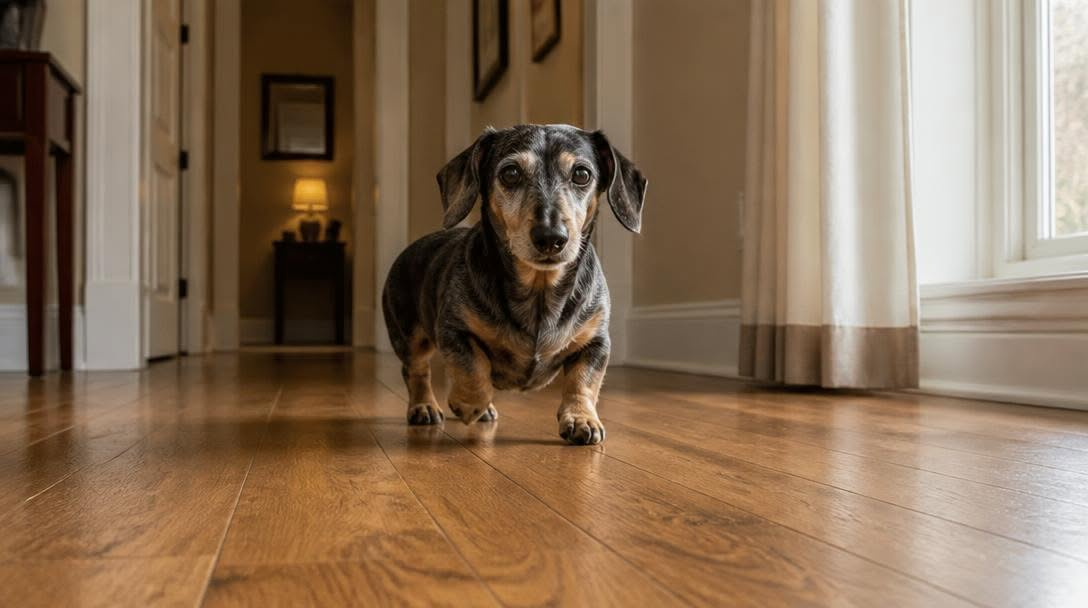
I mentioned earlier that nail length affects gait, and it’s worth connecting that to the bigger picture of aging in this breed. A dachshund who’s compensating for overgrown nails for years is putting cumulative, low-grade strain on joints and posture that are already working against a long spine and short legs. This matters even more as dogs get older and traction naturally becomes a bigger concern — I’ve written a whole guide on home safety and traction for senior dachshunds that covers a lot of the same ground from a different angle, and keeping nails short is one of the simplest, cheapest pieces of that prevention.
Think of a good nail-trim routine the same way I think about the rest of grooming on this site: not a cosmetic chore, but a small, repeatable habit that protects the structure of a dog whose body needs a little extra looking-after.
Frequently Asked Questions
How short should a dachshund’s nails actually be?
As a general rule, the nail shouldn’t touch the ground when your dog is standing normally on a hard, flat surface. If you can hear clicking when they walk on a hardwood or tile floor, the nails are too long.
Is a grinder safer than clippers for a dachshund?
For a lot of nervous dogs and nervous owners, yes — a grinder removes the single “cut” moment that causes the most anxiety, and it’s easier to stop gradually as the quick approaches. It does take a bit more patience, since it’s slower than a single clip.
Can I trim my dachshund’s nails myself, or should I always use a groomer or vet?
Plenty of owners trim nails at home successfully once they understand the quick and have a tool they’re comfortable with. If your dog has black nails on every paw and you’re very nervous about it, there’s no harm in having a groomer or vet tech show you once in person before doing it solo.
Why does my dachshund hate nail trims so much more than baths or brushing?
Paws are sensitive, and most dogs (dachshunds especially) don’t love having their feet handled to begin with. Combine that with the noise of clippers and, often, a past bad experience with the quick, and it adds up to one of the more emotionally loaded grooming tasks for this breed specifically.
What if my dachshund only lets me do one or two nails before getting too stressed?
That’s completely fine — do those, stop, and finish the rest over the next day or two. A trim spread across a few short sessions is far better for building trust than forcing a full trim your dog is fighting the whole way through.
The Bottom Line
Nail trims don’t have to be the dreaded event they’ve become in a lot of dachshund households. Once you can find the quick, use a tool that fits your dog’s temperament, and accept that a session or two split over a couple of days is a perfectly good outcome, it becomes routine maintenance rather than a monthly standoff — and it’s one of the easiest things you can do to protect your dachshund’s gait and back over the long run.


