
“How big is my puppy going to get?” It’s one of the most common questions I hear from new dachshund owners, usually asked while they’re staring at an eight-week-old ball of fur that seems to be growing by the day. As Simply Dachshund’s Healthcare Specialist, I think it’s a great question to ask early — because how a dachshund puppy grows, and how much they weigh once they’re full-grown, has real consequences for their long-term health, especially their back.
This guide walks through what dachshund growth actually looks like month by month, gives you real weight ranges for both standard and miniature dachshunds, and explains why I pay so much closer attention to a growing puppy’s weight than most breed guides bother to mention.
How Fast Do Dachshund Puppies Grow?
Dachshund puppies do almost all of their growing in the first six months of life, then spend the next six months filling out and finishing up. It’s a faster timeline than most people expect from a dog that’s going to live well into their teens.
As a rough rule of thumb, a dachshund puppy reaches:
- About 50% of their adult weight by 4 months old
- About 75-80% of their adult weight by 6 months old
- Close to full height by 9-10 months, though they’ll keep adding some weight and muscle after that
- Full adult size by 12-14 months, once growth plates have closed
Miniature dachshunds tend to finish growing slightly earlier than standards, sometimes by 10-11 months, simply because there’s less growing to do. Standards can keep filling out in small ways until closer to 14 months.
Dachshund Puppy Weight Chart: Standard vs. Miniature
One thing I always tell new owners: these numbers are guidelines, not guarantees. Littermates can grow at noticeably different rates, and a puppy’s eventual size depends on genetics, sex, and how they were fed as much as anything else. Use this as a general reference point, not a strict prediction.
Standard Dachshund (adult weight typically 16-32 lbs)
- 8 weeks: 3-5 lbs
- 12 weeks: 5-8 lbs
- 4 months: 8-13 lbs
- 6 months: 12-20 lbs
- 9 months: 15-27 lbs
- 12 months: 16-32 lbs (adult weight for most)
Miniature Dachshund (adult weight typically under 11 lbs)
- 8 weeks: 1.5-2.5 lbs
- 12 weeks: 2.5-4 lbs
- 4 months: 3.5-6 lbs
- 6 months: 5-8 lbs
- 9 months: 6-10 lbs
- 12 months: under 11 lbs (adult weight for most)
If you’re not sure whether your puppy is trending standard or miniature, weight at 8-12 weeks combined with the size of the parents (if you know them) is usually the best early indicator. When in doubt, ask your breeder or vet — they’ll often have a better read on it than a chart ever will.
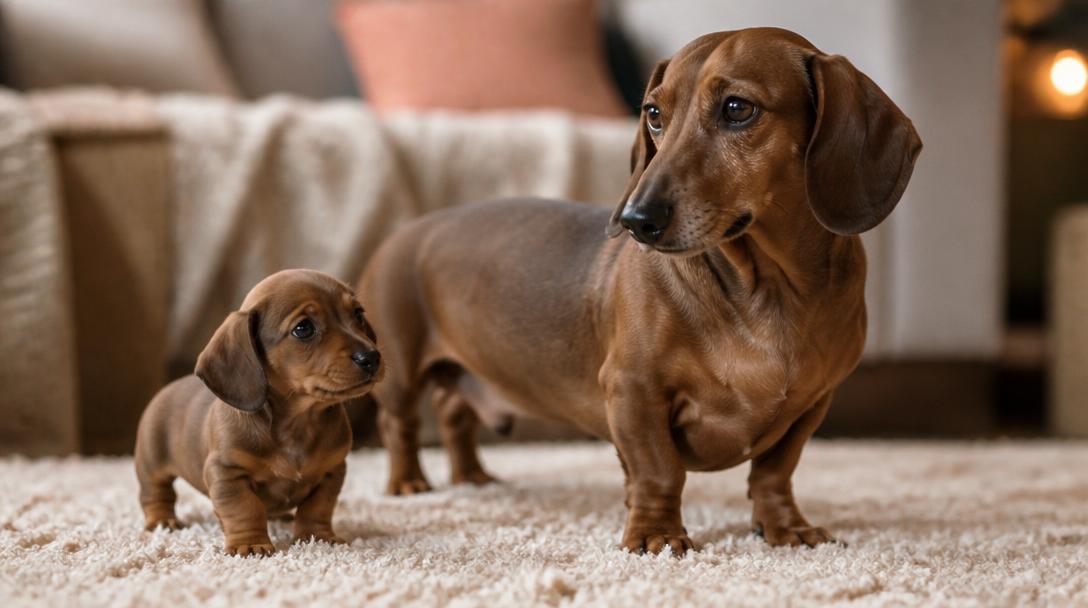
Growth Milestones Month by Month
Weight is only part of the picture. Here’s what’s happening developmentally at each stage, which I find helps owners understand why the scale moves the way it does.
Birth to 8 Weeks
This stage happens mostly with the breeder or previous owner. Puppies are nursing, opening their eyes around 2 weeks, and starting to explore by 3-4 weeks. Weight gain is rapid and almost entirely fueled by mother’s milk or a quality puppy formula.
2 to 6 Months
This is the steepest part of the growth curve — the stretch where you’ll swear your puppy looks different every week. It’s also when baby teeth come in and then start falling out (I cover that timeline in detail in my puppy teething guide if you want the specifics). Bones, joints, and growth plates are all actively developing during this window, which is exactly why I recommend limiting hard jumping, rough play with much larger dogs, and stairs as much as reasonably possible at this stage.
6 to 12 Months
Growth slows down noticeably. Height is mostly locked in by this point, but puppies are still adding muscle and finishing out their frame. Growth plates typically close somewhere between 10 and 14 months depending on the individual dog — this is the point where a puppy’s skeleton is considered mature.
12 Months and Beyond
Most dachshunds have reached their adult height and are close to their adult weight by their first birthday, though some standards keep adding small amounts of muscle and fill until 14-16 months. From here on, weight changes are about diet and activity level, not growth.
When Do Dachshunds Stop Growing?
In short: height and skeletal growth are essentially finished by 10-12 months for most dachshunds, with growth plates fully closed shortly after. Miniatures often finish a touch earlier, standards a touch later. Weight can still shift a bit in either direction after that as a dog matures into their adult frame, but if your one-year-old dachshund still seems to be growing rapidly, that’s worth a conversation with your vet rather than something to assume will just sort itself out.
What Affects How Big Your Puppy Gets
A few factors influence where a dachshund puppy actually lands on that weight chart:
- Genetics. The single biggest factor. Parent size is the best predictor available, which is part of why buying from a reputable breeder who can show you both parents matters.
- Sex. Male dachshunds tend to run slightly larger than females within the same variety, though the difference is usually modest.
- Nutrition. Underfeeding stunts growth; overfeeding accelerates weight gain past what a puppy’s developing joints and spine are ready to support. Neither extreme is something I want to see in a growing dachshund.
- Spay/neuter timing. Dogs altered very early can sometimes grow slightly taller than they otherwise would have, since the growth-plate-closing hormones are affected. This is a conversation to have with your vet rather than a DIY decision.
Tracking Growth: Body Condition, Not Just the Scale
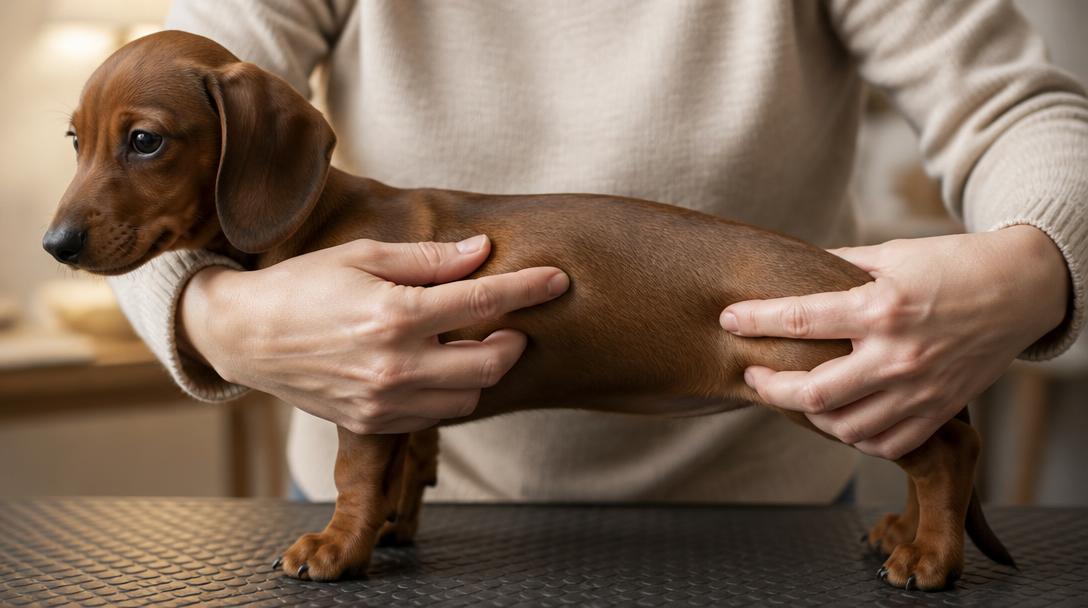
I’d rather owners learn to read their dachshund’s body condition than fixate purely on a number on the scale, because “normal” weight varies a fair amount between individual dogs even within the same variety. Here’s the quick check I walk owners through:
- Ribs: You should be able to feel them easily with light pressure, without them being visible.
- Waist: Looking down from above, there should be a visible tuck-in behind the ribs, not a straight line from chest to hips.
- Side profile: The belly should tuck up slightly behind the ribcage rather than hanging level with the chest.
If you can’t feel ribs at all, or there’s no waist tuck, that’s a sign a puppy (or adult dog) is carrying more weight than is healthy — regardless of what the chart says they “should” weigh at that age.
Why I Watch Puppy Weight So Closely
Here’s the part of this guide that’s specific to why I take dachshund growth seriously in a way a lot of general breed sites gloss over: dachshunds are genetically predisposed to intervertebral disc disease (IVDD), and excess body weight is one of the biggest controllable risk factors for it. A long spine and short legs were never designed to carry extra padding comfortably, and every additional pound puts more day-to-day strain on a back that’s already working harder than most.
That’s exactly why I encourage owners to build good weight habits from puppyhood rather than waiting until adulthood to think about it. A lean, appropriately-fed puppy that grows at a steady, unhurried pace tends to become a lean adult with meaningfully lower lifetime back-injury risk. I go into this connection in a lot more depth, along with the day-to-day habits that protect a dachshund’s spine, in my guide to dachshund spinal health and IVDD prevention — it’s one of the most important things I write about, honestly.
When to Call the Vet About Growth
Most growth variation is completely normal. But I’d get in touch with your vet if you notice:
- A puppy that seems to have stopped growing or is losing weight after 8-10 weeks
- Weight gain that seems to be accelerating well past the ranges above
- Visible lethargy, limping, or reluctance to move alongside a growth spurt
- A puppy that’s noticeably smaller or larger than every littermate by a wide margin
None of these automatically mean something is wrong, but they’re worth a quick check rather than a “wait and see.”
Frequently Asked Questions
How much should an 8-week-old dachshund puppy weigh?
Most 8-week-old dachshund puppies weigh between 1.5 and 5 lbs, depending heavily on whether they’re trending miniature or standard. A miniature puppy at this age is often under 2.5 lbs, while a future standard can already be pushing 5 lbs.
At what age is a dachshund considered full-grown?
Most dachshunds reach their adult height by 9-10 months and their full adult weight and muscle fill-in by 12-14 months, once growth plates have closed.
How can I tell if my dachshund puppy will be a miniature or standard?
The clearest early clues are the size of the parents and your puppy’s weight at 8-12 weeks. If you don’t know the parents’ sizes, your breeder or vet can often give you a reasonable estimate once your puppy is a few months old.
Is it bad if my dachshund puppy is growing faster than the chart shows?
A little variation is normal, but rapid weight gain well above these ranges is worth mentioning to your vet — it can mean a puppy is being overfed relative to what their frame and joints can comfortably support.
Does neutering or spaying affect how big my dachshund gets?
It can, slightly. Altering a dog very early can delay growth plate closure, sometimes resulting in a slightly taller adult. It’s a minor effect, but it’s one more reason to talk timing over with your vet rather than defaulting to the earliest possible age.
A Steady Pace Is a Healthy Pace
If there’s one thing I want owners to take from this guide, it’s that slow and steady really is the goal with a growing dachshund puppy. You don’t need to hit every number on this chart exactly — you need a puppy that’s eating well, staying lean, and developing at a pace their body can keep up with. Get that right early, and you’re setting up the back and joints you’ll be caring for well into their teens.
If you’re just bringing a puppy home, my Dachshund Puppy Checklist covers everything else you’ll want ready before day one.