I get some version of this question every week from new dachshund owners: “What do I actually need to puppy-proof?” And I get why — most puppy-proofing advice online is written for dogs in general, and a dachshund’s body doesn’t work like most dogs. A low-slung, long-backed puppy faces hazards that a Labrador puppy simply doesn’t, and a lot of the standard advice (baby gates are enough, just watch the electrical cords) misses the risks that actually send dachshunds to my exam table. I’m Rex, and healthcare is my corner of this site. So let’s go room by room and build a puppy-proofing plan that accounts for the one thing every other checklist forgets: that spine.
Why Puppy-Proofing a Dachshund Is Different
Most puppy-proofing guides are written with a generic, average-sized dog in mind — one whose main risks are chewing cords, eating something off the counter, or getting into the trash. Those risks apply to dachshund puppies too, but they’re not the ones that worry me most. A dachshund’s elongated spine and short legs mean their single biggest lifelong health risk is intervertebral disc disease (IVDD) — a condition where the cushioning discs between vertebrae bulge or rupture, sometimes causing pain, and in severe cases, partial or full hind-leg paralysis. Roughly a quarter of dachshunds will develop some form of disc disease in their lifetime, and the habits that protect (or damage) a dachshund’s back often start in puppyhood, before an owner even realizes it matters.
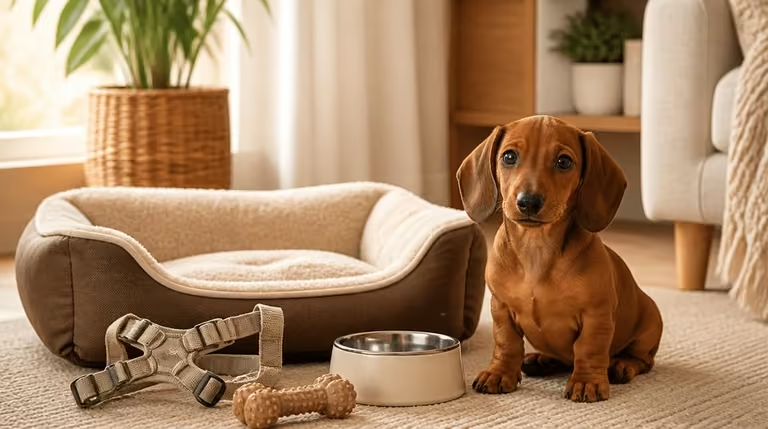
That means a proper dachshund puppy-proofing plan isn’t just about what your puppy might chew or swallow — it’s about controlling every surface your puppy can jump on or off of, every set of stairs they can access, and every piece of furniture at a height that invites a leap. Add in a young dachshund’s stubborn curiosity and low-to-the-ground nose that finds every gap, crumb, and loose wire in a room, and you’ve got a breed that genuinely needs its own puppy-proofing checklist — not a repurposed one. If you haven’t already gathered your puppy’s actual gear yet, my colleague Hank put together a great Dachshund Puppy Checklist covering everything you need before bringing your puppy home. Think of this post as the safety pass you do once that gear (and your puppy) has arrived.
The #1 Priority: Jump and Fall Prevention
If I could get new dachshund owners to fix just one category of hazard, it would be this one. A dachshund puppy’s spine is still developing, and repeated jumping on and off furniture, or awkward falls down stairs, can contribute to disc problems well before adulthood. I go into the full mechanics of why this matters in my post on Dachshund Spinal Health and IVDD prevention, but for puppy-proofing purposes, here’s what to physically change in your home:
- Block stair access. A puppy gate at the top and bottom of any staircase is non-negotiable. Dachshund puppies are surprisingly determined climbers, but their bodies aren’t built for the repeated impact of descending stairs, and a tumble down even a few steps can cause a serious injury.
- Limit sofa and bed access — or make it safe. Rather than fighting a losing battle to keep your puppy off the furniture, install pet ramps or stairs next to your couch and bed from day one. Puppies who learn to use a ramp instead of jumping tend to keep using it as adults, and building that habit early is far easier than retraining a grown dog.
- Watch for gaps and drop-offs. Elevated porches, raised patios, tall garden beds, and even a single unguarded step from a kitchen to a sunken living room are all jump-off points a puppy will attempt before you’ve had a chance to intervene.
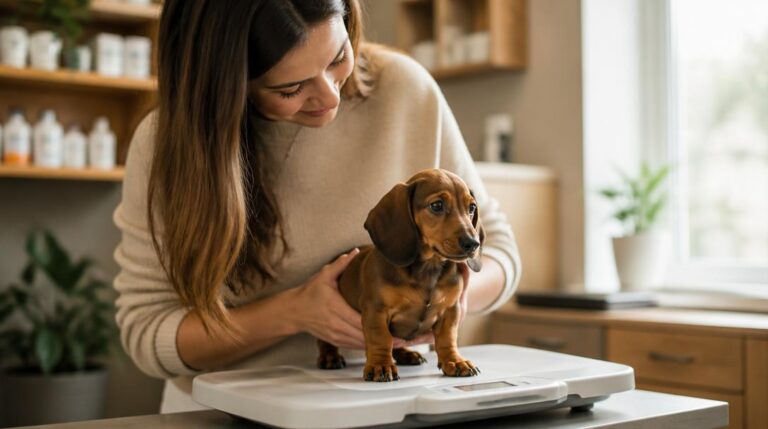
- Be deliberate about pick-up and carry technique. This isn’t strictly “proofing your home,” but it belongs on every dachshund puppy-proofing list: always support the chest and hindquarters together when lifting, never let a puppy dangle or twist, and teach kids in the house the same rule.
Kitchen Hazards
Dachshund puppies are low to the ground and endlessly food-motivated, which makes the kitchen one of the riskiest rooms in the house.
- Secure the trash can. A step-can with a foot pedal or a can stored behind a cabinet door is worth the investment — a dachshund’s nose will find anything edible (or dangerous) in an open bin within minutes.
- Toxic foods stay off the counter edge. Onions, garlic, grapes, raisins, chocolate, and anything sweetened with xylitol are all genuinely dangerous, and a determined puppy will counter-surf for a dropped crumb of any of them.
- Watch the cabinet under the sink. Cleaning products, dish detergent pods, and trash bags often live here, and a standard cabinet latch that stops a toddler won’t necessarily stop a puppy’s nose and paws working at the same problem for twenty uninterrupted minutes.
- Stove and oven cord awareness. If your stove has a dangling appliance cord (coffee maker, slow cooker) at counter height, tuck it back — a curious puppy grabbing and pulling can bring a hot or heavy appliance down.
Living Room and Bedroom Hazards
- Electrical cords. Puppies teethe on everything at floor level, and a dachshund’s body puts them at direct eye level with every outlet strip and lamp cord in the room. Use cord covers or route cords behind furniture out of reach.
- Small objects and choking hazards. Coins, buttons, hair ties, phone chargers, and small toy parts are all things a dachshund puppy’s nose will investigate mouth-first. A quick “puppy’s-eye-view” crawl through each room — literally getting down at their height — is the single best way to spot what you’re missing.
- Houseplants. Several common houseplants (lilies, pothos, sago palm, and aloe among them) are toxic to dogs. If you’re not sure about a plant you already own, it’s worth a quick check against the ASPCA’s toxic plant list before your puppy gets curious about it.
- Blind and curtain cords. These pose a strangulation risk to small dogs who can get tangled while playing near a window. Tie them up out of reach or switch to cordless blinds if you’re renovating anyway.
- Recliners and rocking chairs. These are a genuinely underrated hazard — a puppy small enough to wedge under the footrest or behind the mechanism of a reclining chair can be seriously injured when it’s operated. Keep puppies away from moving furniture entirely until they’re older and more furniture-savvy.
Bathroom and Laundry Room Hazards
- Keep the toilet lid down. Beyond the obvious, cleaning tablets or bowl fresheners left in the toilet water are toxic if a puppy drinks from it.
- Store medications up and closed. Any dropped pill — yours or the puppy’s own — should never be reachable. Pill bottles on a low bathroom counter or nightstand are a common source of emergency vet visits.
- Laundry pods and dryer sheets. Both are appealing to a chewing puppy and both are toxic. Keep laundry supplies on a shelf, not the floor next to the machine.
- Never leave the dryer door open unsupervised. Small dogs occasionally climb into warm laundry piles, including inside an open dryer. Always do a visual check before you start a load.
Garage, Yard, and Outdoor Spaces
- Antifreeze and other automotive fluids. Antifreeze has a sweet taste dogs are drawn to and is extremely toxic even in small amounts. Store it sealed and well off the ground, and clean up any driveway drips immediately.
- Fencing gaps. A dachshund puppy’s long body and short legs are deceptively good at squeezing through gaps that look too small. Walk your fence line at puppy height and check gate gaps, not just the fence panels themselves.
- Garden chemicals and mulch. Cocoa mulch is toxic to dogs and smells appealing to a curious nose. Fertilizers, pesticides, and slug bait should be stored out of reach and reapplied only per label safety intervals.
- Digging and escape routes. Dachshunds were bred to dig and tunnel, so check for gaps under fences or gates a puppy could widen over time — this breed is more motivated than most to make an opening bigger.
- Temperature extremes. A dachshund’s short legs put their belly close to hot pavement in summer and cold ground in winter. Limit outdoor time accordingly, especially for a puppy who hasn’t built up tolerance yet.
A Few Habits That Matter as Much as Physical Changes
Puppy-proofing isn’t only about objects and rooms — it’s also about the routines you build from week one:
- Use a crate or playpen when you can’t supervise directly. This is the single most effective “puppy-proofing” tool there is, because it removes the guesswork entirely during the hours you’re not watching.
- Do a room-by-room crawl before your puppy’s first day home, and again every few weeks. Puppies grow fast, and a hazard that was out of reach at 8 weeks old may be reachable by 14 weeks as they get taller and more confident jumping.
- Involve everyone in the household in the “no picking up and holding at chest height while standing” rule. Falls from a person’s arms are one of the most common causes of injury I see in young dachshunds, and it’s almost always well-intentioned kids or guests who don’t know the risk.
Frequently Asked Questions
At what age can a dachshund puppy safely use the stairs?
There’s no universal age, but most vets recommend keeping a dachshund puppy off stairs entirely until they’re fully grown (usually around 10-12 months) and, ideally, limiting stair use for life. If stairs are unavoidable in your home, teach a slow, supervised routine rather than free access, and consider a ramp for any stairs they’ll use daily.
Is it true dachshunds shouldn’t jump on or off furniture at all?
The safest approach is to prevent jumping entirely by using ramps or steps and by lifting your puppy down yourself when needed. Some adult dachshunds go their whole lives without back problems despite occasional jumping, but since you can’t predict which dog is vulnerable, prevention from puppyhood is the better bet.
What household plants are safe to keep with a dachshund puppy?
Spider plants, Boston ferns, and African violets are generally considered non-toxic options. When in doubt about a specific plant you already own, check it against the ASPCA’s toxic and non-toxic plant lists rather than guessing.
My puppy already jumped off the couch a few times before I read this — should I panic?
No. An occasional jump isn’t a guaranteed injury, and most puppies do it before owners catch on. The goal going forward isn’t perfection, it’s reducing the frequency as much as possible with ramps, gates, and supervision from here on out.
Building the Habit Early Pays Off for Life
None of this requires an expensive renovation — it’s mostly gates, ramps, a few cabinet latches, and a habit of getting down at puppy height to see your home the way they do. The payoff is real: the spine and joint habits you build in these first few months are the ones that tend to stick for your dachshund’s whole life. If you want to go deeper on the “why” behind all this stair and jumping caution, my post on Dachshund Spinal Health covers IVDD prevention in much more detail. For now, walk your home room by room this week, make the changes above, and you’ll have done more for your puppy’s long-term back health than most owners ever think to.