A reader emailed me a few weeks back asking if it was actually true that the mascot of the 1972 Munich Olympics was a dachshund, or if she’d misremembered something from a trivia night. I get some version of this question more than you’d think — usually it’s a rumor about a famous painter’s dog, or a half-remembered fact about a president’s pet. So I decided to actually run down the full list of famous dachshunds in history, and it turns out this breed has been quietly showing up next to some of the most recognizable names of the last two centuries.
What struck me putting this together is that it’s not a coincidence. The same traits that make dachshunds wonderful house pets — the stubborn personality, the unmistakable silhouette, the way they attach themselves to one person and refuse to leave — are exactly what made them irresistible to painters, photographers, and public figures who wanted a dog with real character. Here are the famous dachshunds who left their mark on art, history, and pop culture, and what made each of them memorable.
Waldi, the Dachshund Who Became the First Official Olympic Mascot
This is the one that surprises people most, and it’s completely true. When the 1972 Summer Olympics came to Munich, German designer Otl Aicher created a striped dachshund character named Waldi to represent the Games — and Waldi has the distinction of being the first officially sanctioned mascot in Olympic history. He wasn’t an abstract cartoon, either. Aicher modeled Waldi’s proportions on a real long-haired dachshund named Cherie von Birkenhof, and the design was meant to capture the qualities Aicher associated with the breed: resistance, tenacity, and agility.
The dachshund connection ran deeper than a logo on a poster. Munich’s 1972 marathon course was laid out so that, viewed from above, its shape traced Waldi’s outline. Merchandise sold in the millions — more than two million Waldi items, by most counts — making him one of the most successful mascot campaigns of the era. Aicher also deliberately kept black and red out of Waldi’s color palette, steering clear of any visual echo of Germany’s recent past and leaning instead into the bright, optimistic “Rainbow Games” theme Munich wanted the world to see. A humble low-slung house dog became the face of an Olympic Games watched by hundreds of millions of people, and honestly, I don’t think any other breed could have pulled off that combination of dignity and charm.
Lump, the Dachshund Who Lived in Picasso’s Home
In 1957, photographer David Douglas Duncan brought his dachshund to visit Pablo Picasso at his home in the south of France — and the dog, named Lump (German for “rascal” or “scamp”), never really left. Picasso was taken with him almost immediately, and Lump ended up living at the Picasso household for roughly six years, showing up in a number of the artist’s works, including a well-known reinterpretation of Velázquez’s Las Meninas where Picasso swapped out the original painting’s mastiff for his own small, confident dachshund. Duncan later documented the relationship in a book, Picasso & Lump: A Dachshund’s Odyssey, which is still the best account of just how attached one of the twentieth century’s most famous artists became to a dog who, by most descriptions, knew exactly how good he had it and acted accordingly.
Archie and Amos, Andy Warhol’s Constant Companions
Andy Warhol wasn’t exactly known for sentimentality, which is part of what makes his devotion to his dachshunds so memorable. His first, Archie, went everywhere with him — gallery openings, dinners, even interviews, where Warhol would sometimes let Archie do the talking for him when he didn’t feel like answering a question himself. Warhol once said his dog was smarter than some people he knew, and by most accounts he wasn’t entirely joking. When Archie was later joined, and eventually followed, by a second dachshund named Amos, the pair became something like fixtures of Warhol’s Factory-era social circle, appearing in photographs alongside some of the most famous cultural figures of the 1970s and 80s. It’s a good reminder that this breed’s appeal isn’t really about status or trend — it’s that once a dachshund decides you’re their person, they mean it.
Stanley and Boodgie, David Hockney’s Painted Muses
British artist David Hockney painted his two dachshunds, Stanley and Boodgie, more than forty times over the years, eventually collecting the work into a book called David Hockney’s Dog Days. Hockney has described the pair with real affection — two dogs who wanted, in his words, for only two things: food and love. What I find most charming about this one is how ordinary the paintings are compared to Hockney’s more famous work. These aren’t grand studio commissions; they’re quick, tender sketches of two dogs curled up asleep, tangled together on a chair, or watching him work. It’s one artist’s honest documentation of exactly the kind of scene most dachshund owners recognize from their own living rooms.
Queen Victoria and the Dachshund’s Rise in Royal Britain
Long before any of the above, Queen Victoria helped put dachshunds on the map in Great Britain. She kept a series of them throughout her reign in the 1800s, and her very public fondness for the breed is widely credited as one of the reasons dachshunds became fashionable among the British upper class during that period — a pattern that repeats throughout this list, honestly. Royals and public figures showcase a breed, and suddenly everyone wants one. I wrote more about how the dachshund evolved from a working badger hunter into a beloved companion breed in an earlier piece, and Victoria’s patronage is a meaningful chapter in that shift — it’s part of how a specialized German hunting dog ended up as one of the most recognizable household pets in the English-speaking world.
Dunker, the Dachshund Who Belonged to a Future President
Before he was President, a young John F. Kennedy kept a dachshund named Dunker while he was living in England in the years before World War II, during a stretch when his father served as U.S. Ambassador to the United Kingdom. It’s a small footnote in a much larger biography, but it’s a fun one — one more entry in the long list of dachshunds who happened to be at the side of someone who’d go on to make history of their own.
Louis, Adele’s Modern-Day Dachshund
Fame and dachshunds aren’t just a story from the last century, either. Singer Adele has been photographed and has spoken publicly about her dachshund Louis for years, and he’s become something of a recurring character in interviews and social media the way Archie was for Warhol decades earlier. It’s a nice bit of proof that nothing about this breed’s appeal has faded — whether you’re a Grammy-winning singer or a reader emailing me a trivia question, the pull of a dachshund’s personality works exactly the same way it did when Queen Victoria was on the throne.
Why Artists, Royals, and Celebrities Keep Choosing Dachshunds
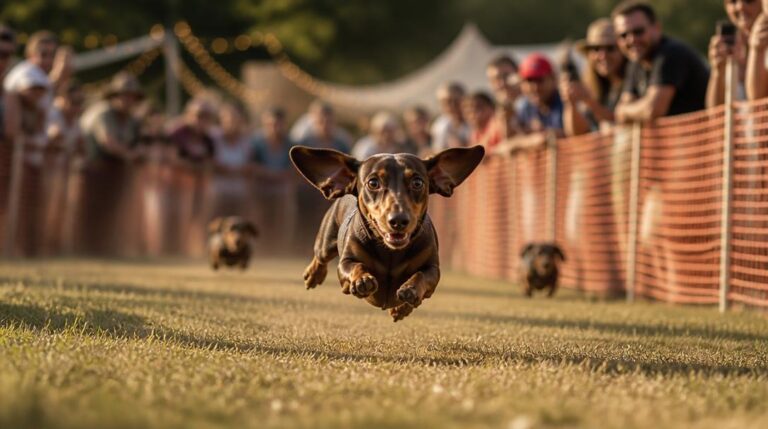
Looking at this list all together, a pattern jumps out. Painters loved dachshunds because they hold a pose and have an expressive, almost human face that’s genuinely fun to render. Public figures loved them because the silhouette is instantly recognizable and impossible to confuse with any other breed — a dachshund photographed next to someone famous reads as a personality choice, not just a pet. And everyone, famous or not, ends up loving them for the same reason: they’re funny, fiercely loyal to their person, and completely unbothered by anyone else’s opinion of them. That’s the same stubborn, larger-than-life personality that shows up at wiener dog races around the country every summer — it’s just been playing out on a much bigger stage for a couple hundred years.
Frequently Asked Questions
Was the 1972 Olympics mascot really a dachshund?
Yes. Waldi, designed by Otl Aicher for the 1972 Munich Summer Olympics, was modeled on a real long-haired dachshund and is recognized as the first official mascot in Olympic history.
Did Picasso actually own a dachshund?
He didn’t technically own Lump — the dog belonged to photographer David Douglas Duncan — but Lump lived at Picasso’s home for roughly six years and appeared in several of his artworks, including a reworking of Las Meninas.
What breed did David Hockney paint most often?
Hockney is best known among dog lovers for his many paintings of his two dachshunds, Stanley and Boodgie, later collected into the book David Hockney’s Dog Days.
Which modern celebrities own dachshunds?
Adele is one of the most visible current examples, regularly photographed with her dachshund Louis, continuing a long tradition of public figures with a soft spot for the breed.
Why have so many artists and public figures chosen dachshunds specifically?
Their distinctive silhouette, expressive face, and strong, loyal personality make them both visually memorable and genuinely rewarding companions — qualities that have appealed to painters, royals, and celebrities alike for well over a century.
The Bottom Line
Every dog on this list — an Olympic mascot, an artist’s muse, a queen’s companion, a future president’s pet, a modern pop star’s constant sidekick — got there the same way any dachshund wins over the person in front of them: stubbornly, affectionately, and completely on their own terms. It’s a nice thing to remember the next time your own dachshund is refusing to budge from your lap. You’re in good company.