
I’ve spent a lot of years looking at dachshunds — mine, yours, the ones that show up in my inbox every week from readers who want to talk about their wiener dog’s latest antics. So it still catches me off guard sometimes to remember that some of the most important artists of the 20th century looked at this exact same low-slung, barrel-chested little dog and saw a muse. Not a mascot. Not a punchline. A genuine creative partner.
This isn’t a story about dachshunds showing up in art once, as a cute prop. It’s a story about several of the most influential artists of the modern era keeping dachshunds specifically, painting and photographing them for years at a time, and letting those dogs shape the work itself. If you love this breed the way I do, I think you’ll find it as wonderful as I do that Picasso, Andy Warhol, and David Hockney were all, in their own ways, dachshund people first.
Why Artists Keep Falling for This Breed
Before we get into the specific dogs and the specific artists, it’s worth asking why. Dachshunds have a silhouette unlike almost any other dog — that long low body, the oversized ears, the expressive, slightly mournful eyes. It’s a shape that reads instantly, even reduced to a few lines, which is exactly the kind of visual economy a painter or illustrator loves. Add in the breed’s famously strong, often stubborn personality, and you get an animal that isn’t just fun to look at — it’s fun to be around while you work. Several of the artists below kept their dachshunds in the studio with them for exactly that reason: companionship with opinions.
Picasso and Lump: The Dachshund Who Reinvented a Masterpiece
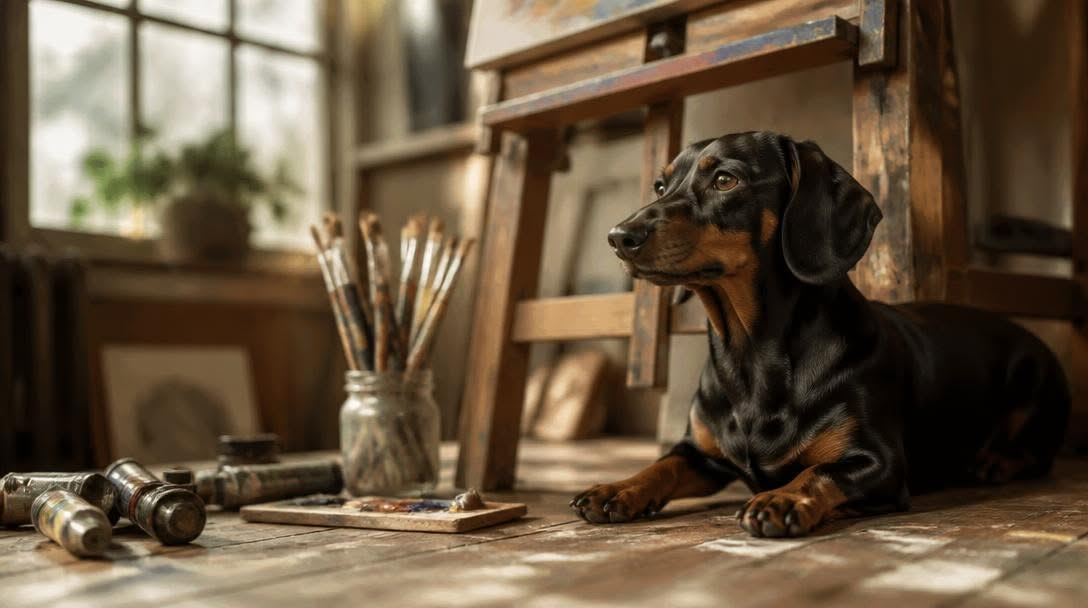
The most famous dachshund in art history is, without much competition, Picasso’s Lump. The story goes that in 1957, photographer David Douglas Duncan brought his dachshund along on a visit to Picasso’s villa in the South of France, and the little dog essentially refused to leave. Picasso was taken with him immediately — legend has it he took one look and said “this is not a dog, this is a person” — and Lump ended up staying with Picasso for six years.
What makes Lump more than a sweet anecdote is what he inspired. Picasso was in the middle of reinterpreting Diego Velázquez’s 17th-century masterpiece Las Meninas, a project that eventually produced 58 separate paintings. Lump worked his way into several of them, including taking the place of the mastiff that appears in Velázquez’s original composition — a deliberate, almost cheeky substitution of a tiny, long-bodied dog for a massive one. Picasso also made a series of standalone sketches and paintings of Lump himself, capturing that unmistakable shape in just a handful of confident lines. For a dog who wandered into a villa uninvited, that’s a remarkable artistic legacy.
Andy Warhol’s Archie and Amos: A Dachshund in the Pop Art Spotlight
Where Picasso’s relationship with Lump was personal and painterly, Andy Warhol’s dachshunds lived a much more public, much more “Warhol” kind of life. Warhol owned two dachshunds, Archie and later Amos, and Archie in particular became something close to a celebrity accessory — Warhol brought him to interviews, parties, and television appearances throughout the 1970s, often cradling him like a small, opinionated security blanket.
Archie wasn’t just along for the ride, either. He shows up in several of Warhol’s self-portraits and sketches from the period, rendered in that same flat, graphic style Warhol applied to soup cans and movie stars. There’s something genuinely fitting about a dachshund — a breed with such a distinct, instantly recognizable outline — ending up as a subject for an artist obsessed with repetition, silhouette, and instantly recognizable imagery. Warhol’s dachshunds weren’t incidental pets who happened to get photographed; they were woven into how he presented himself as a public figure.
David Hockney’s Stanley and Boodgie: Decades of Devotion on Canvas

If Picasso’s connection to Lump was intense but brief, British artist David Hockney’s relationship with his two dachshunds, Stanley and Boodgie, was the opposite: long, steady, and enormously prolific. Hockney kept the pair as his studio companions for years, and he didn’t just sketch them occasionally — he produced an entire body of work centered on them, eventually collected in a book called Dog Days, filled with dozens of paintings and drawings of the two dogs sleeping, stretching, and lounging around his studio.
What’s striking about Hockney’s dachshund paintings is how unposed they are. These aren’t formal portraits; they’re quick, intimate studies of two dogs just living their lives nearby while he worked — curled on cushions, draped over furniture, napping in sunbeams. Hockney himself described painting them as a kind of meditative practice, something he could return to again and again because the subjects were right there, available, and endlessly watchable. It’s a reminder that a lot of great dachshund art doesn’t come from grand inspiration — it comes from simply paying attention to a dog who’s already in the room.
Beyond the Canvas: Dachshunds in Illustration, Design, and Everyday Art
Fine art is only part of the story. That same instantly readable silhouette has made dachshunds a favorite subject well outside gallery walls — in children’s book illustration, editorial cartoons, logo design, and folk art for decades. The breed’s shape is so graphically distinctive that illustrators often use it as visual shorthand for “small dog with a big personality,” and you’ll find dachshund motifs stitched into needlepoint, carved into folk sculpture, and printed on everything from greeting cards to gallery prints sold at art fairs across the country. It’s a nice echo of what drew Picasso, Warhol, and Hockney to the breed in the first place: a shape that works in almost any medium, at almost any scale.
What This Says About the Breed We Love
I don’t think it’s an accident that three of the most important artists of the last century all gravitated toward the same breed. Dachshunds are visually bold, endlessly expressive, and genuinely good company — the kind of dog who doesn’t just sit in a studio but becomes part of the work happening inside it. If you’ve ever tried to sketch your own dachshund and found yourself charmed all over again by how much personality comes through in that one simple shape, you’re in very good company. For more on the long history behind this remarkable little breed, take a look at our deep dive into the dachshund’s origins as a badger hunter, and if art-world fame has you curious about dachshunds who made their mark in other ways, our piece on famous dachshunds throughout history is a great next read.
Frequently Asked Questions
Did Picasso actually own Lump, or was he just visiting?
Lump technically belonged to photographer David Douglas Duncan, but after their first meeting in 1957, the dachshund essentially lived with Picasso at his villa for six years. Picasso treated him very much as his own, and Lump had free run of the household and studio.
What breed were Andy Warhol’s dogs, exactly?
Both Archie and Amos were dachshunds. Archie was the more publicly visible of the two, frequently appearing with Warhol at interviews and public events throughout the 1970s.
Is Dog Days by David Hockney easy to find?
Hockney’s Dog Days has been published in book form and reprinted over the years, collecting dozens of his sketches and paintings of Stanley and Boodgie. Larger libraries and art bookstores are generally the best places to track down a copy.
Why do artists seem especially drawn to dachshunds compared to other small breeds?
A lot of it comes down to silhouette. The dachshund’s long, low body and oversized ears create an instantly recognizable shape that works well in almost any artistic style, from loose sketches to graphic pop art. Combine that with the breed’s famously strong personality, and you get a subject that’s both visually distinctive and genuinely engaging to spend time with.
A Muse With Four Short Legs
From a Spanish villa in the 1950s to a New York loft in the ’70s to a quiet studio in England filled with dog beds and half-finished canvases, dachshunds have had a real seat at the table in modern art history. It’s one more reason to love this strange, wonderful little breed — and if your own dachshund has ever struck a pose worth sketching, you’re following in some very good footsteps. Got a dachshund story of your own worth telling? We’d love to hear it — drop by and share it with the rest of the pack.


