
I get asked this one a lot, usually by someone standing at a trailhead looking down at their dachshund and wondering if they’ve made a terrible mistake: “Can my dog actually do this?” The short answer is yes – dachshunds can absolutely go hiking, and plenty of them love it. The longer, more honest answer is that this breed’s unusual body means hiking looks a little different for a dachshund than it does for a Lab or a husky, and getting it wrong can mean a sore dog at best and a back injury at worst.
I’ve written before about how much exercise a dachshund needs at different ages and about safe exercise for dachshunds with back problems. Hiking sits right in the middle of both of those conversations, because a trail can be one of the best things you do for your dog’s body and mind – or, if you pick the wrong trail or the wrong dog, one of the more avoidable risks to that long spine. Let’s get into what actually matters.
Why Dachshunds Can Make Surprisingly Good Hiking Partners
It’s easy to look at those short legs and assume a dachshund belongs on the couch, not the trail. That assumption is wrong more often than it’s right. Dachshunds were bred to work – tracking and digging out badgers for hours in rough terrain – and that heritage shows up as real stamina, a strong nose, and a dog that genuinely wants a job to do. A healthy adult dachshund with no back issues can often cover several miles on a reasonable trail, sniffing every log and root along the way like it’s the most important work they’ve ever done.
What they don’t have is the stride length, the ground clearance, or the joint tolerance of a bigger breed. A rocky scramble that a German Shepherd barely notices can mean a dachshund’s belly is dragging over stone, or their back is arching and twisting in ways it shouldn’t. So the goal isn’t to avoid hiking – it’s to pick hikes that play to this breed’s strengths and sidestep its one real weak spot.
The Back Is the Whole Ballgame
Every decision about hiking with a dachshund comes back to one thing: intervertebral disc disease, or IVDD. Roughly a quarter of dachshunds will deal with a disc problem at some point in their life, and the discs that cause trouble sit along that long spine between short, sturdy legs. Twisting motions, hard jarring impacts, and repeated jumping on and off uneven surfaces are the specific things that put stress on those discs – and a badly chosen trail can serve up all three in one afternoon.
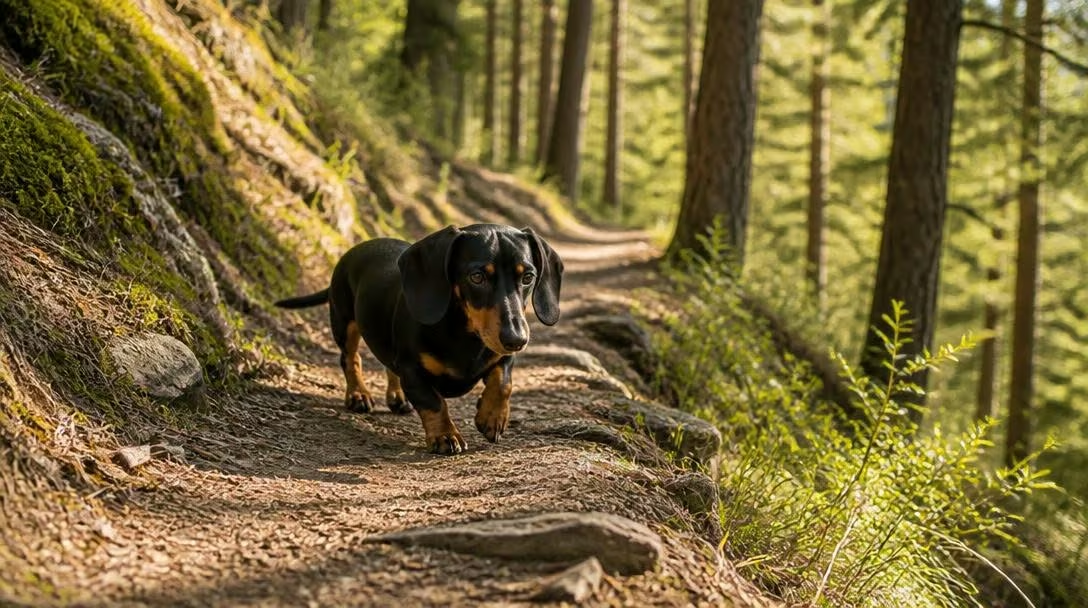
This doesn’t mean every trail is dangerous. It means you’re looking for trails with even footing, gradual elevation change, and no mandatory scrambling over rocks, logs, or steep drop-offs. A flat-to-rolling forest path, a well-maintained rail trail, or a gentle lakeside loop is a very different proposition than a technical scramble with boulder hopping. If you wouldn’t want to carry a 15-pound sack of flour over a given obstacle, don’t ask your dachshund to climb it either – and if there’s any obstacle your dog can’t step over cleanly, pick them up and carry them past it rather than letting them leap.
Choosing the Right Trail
A few concrete things to look for when you’re scouting a hike:
- Surface: Packed dirt, grass, or gravel beats loose scree, slick rock, or deep mud. Smooth and predictable footing is kinder to a long back than anything that makes a dog scramble or slip.
- Elevation profile: Gentle, rolling grades are fine. Steep switchbacks with big rock steps are the kind of thing that forces repeated jumping and twisting – exactly what you’re trying to avoid.
- Water crossings: A shallow, slow stream your dog can wade is fine. A crossing that requires jumping between rocks is not – that’s a classic way dachshunds get hurt on otherwise lovely trails.
- Length: Start shorter than you think you need to. A 1–2 mile loop is a completely reasonable first hike for most adult dachshunds; you can build up from there once you know how your particular dog handles it.
- Season and surface temperature: Those short legs put a dachshund’s belly closer to hot pavement or sun-baked rock than a taller dog’s. On warm days, stick to trails with shade and natural ground cover, and check the surface temperature with your own hand before you commit to it.
Rail trails, converted canal towpaths, and well-groomed park and conservation-land loops tend to check every one of these boxes, which is why they’re such a reliable starting point if you’re new to hiking with your dog.
Gear That Actually Helps
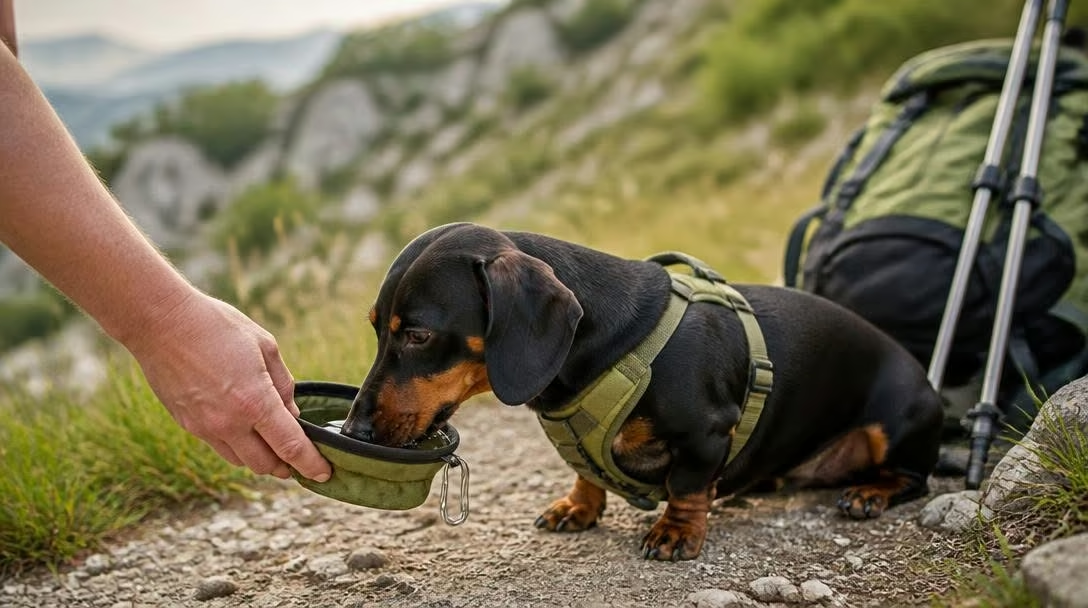
A harness, not a collar, is non-negotiable for trail walking. Any sudden pull or lunge toward a squirrel puts all the force on a collar straight through the neck and front of the spine; a well-fitted harness spreads that force across the chest instead. Beyond that, a few things are worth packing:
- A sturdy leash with some give to it – a bit of shock absorption helps on uneven ground.
- Collapsible water bowl and more water than you think you’ll need. Dachshunds overheat faster than their size suggests.
- A basic first-aid kit, including something to flush a paw pad if it picks up a thorn or burr.
- Paw protection if the trail has rough gravel, hot pavement, or ice – dachshund paw pads aren’t tougher than any other breed’s, just closer to the ground.
- A sling-style carrier or simply the willingness to carry your dog for the last stretch if they tire out. There’s no shame in it, and it’s a lot cheaper than a vet visit.
Reading Your Dog on the Trail
Dachshunds are stubborn and proud, which means a lot of them will keep trotting along cheerfully well past the point where they should have stopped. It’s on you to watch for the early signs of fatigue or discomfort rather than waiting for your dog to tell you in an obvious way. Watch for lagging behind where your dog was previously keeping pace, a change in gait or a slight hunch in the back, excessive panting that doesn’t settle during a rest, or reluctance to jump even small steps they’d normally hop over without thinking. Any one of those is a sign to slow down, offer water, and consider turning back rather than pushing on.
If you ever see your dog yelp, suddenly refuse to move, or hold their back in a hunched, rigid posture, treat that as a possible back injury and stop the hike immediately – carry them back to the car and call your vet. It’s always better to cut a hike short on a false alarm than to let a genuine injury get worse over another mile.
Building Up Trail Fitness Gradually
If your dachshund hasn’t done much hiking before, treat trail fitness the same way you’d treat any new exercise program – start small and build gradually. A few short, easy walks on varied but gentle terrain over a couple of weeks will tell you a lot about how your dog handles uneven ground before you commit to a longer outing. From there, add distance in modest increments rather than jumping straight from a neighborhood walk to a five-mile trail.
This matters more for puppies and seniors than for a fit adult dog. Puppies shouldn’t do serious hiking until their growth plates have closed – generally somewhere around 12 to 18 months for this breed – since repetitive impact on an immature skeleton carries its own risks. Senior dachshunds can often still enjoy gentle trails well into their later years, just with shorter distances, more frequent breaks, and a closer eye on how they’re moving the next day. If your dog is overweight, hiking is a great long-term goal, but it’s worth getting their weight into a healthier range on flat ground first – extra weight is one of the single biggest contributors to back injury in this breed, and a hilly trail is not the place to start that process.
A Few Trail Scenarios Worth Planning For
Wildlife encounters are worth thinking through ahead of time. That strong hunting instinct that makes dachshunds such enthusiastic trail companions also means a squirrel, chipmunk, or deer can trigger a hard, sudden lunge against the leash – which is exactly the kind of twisting force you’re trying to avoid for their back. Keep the leash reasonably short in areas with a lot of wildlife activity rather than letting it run long and loose.
Other dogs on the trail deserve a little extra caution too, simply because of the size mismatch. A friendly but boisterous larger dog that wants to play rough can accidentally knock a dachshund over or step on them in a way that wouldn’t bother a same-size playmate. It’s fine to let your dog socialize, but stay close enough to step in if a bigger dog gets too enthusiastic.
Frequently Asked Questions
How far can a dachshund hike in one outing?
A healthy adult dachshund with no back history can often manage 2–4 miles on easy-to-moderate terrain once they’re conditioned to it, though every dog is different. Start with shorter loops of a mile or less and build up gradually rather than assuming your dog’s limit in advance.
Is it safe to let a dachshund hike off-leash?
Generally, no – not because of fitness, but because of that strong prey drive and short legs that can get your dog into trouble quickly if they bolt after wildlife. A long training lead on open, obstacle-free trails can offer more freedom while still keeping you in control.
Should I carry my dachshund on part of the hike?
Yes, and there’s no shame in it. Carrying your dog over technical sections, during the last stretch when they’re tired, or any time you see signs of fatigue is a normal, sensible part of hiking with a short-legged dog – not a failure.
What trail features should I avoid entirely?
Steep rock scrambles, trails requiring repeated jumping between rocks or logs, deep loose sand or scree, and anything with a mandatory water crossing that involves jumping rather than wading are all worth skipping with a dachshund.
Can dachshunds with a history of IVDD go hiking at all?
Talk to your vet first if your dog has had a prior disc episode. Many dogs can still enjoy gentle, flat walks after recovery, but the trail selection needs to be even more conservative, and some dogs may be better suited to flat-ground walks than trail hiking going forward.
The Bottom Line
Dachshunds weren’t bred to be porch ornaments, and most of them are happiest with a job to do and new ground to sniff. Hiking can absolutely be part of a healthy, active life for this breed – you just have to do the trail selection a Labrador owner never has to think about. Pick gentle, even terrain, use a harness, pack more water than you think you need, watch your dog’s body language instead of just their enthusiasm, and build up distance gradually. Get those pieces right, and you’ll have a hiking partner who’s just as excited for the next trailhead as you are.


