
I get asked some version of this question at almost every meetup: “Hank, is there anything my dachshund can actually compete in, or are we stuck doing the same three laps around the block forever?” The answer surprises people every time. Dachshunds aren’t just capable of organized dog sports — in a few of them, this breed is basically built for the job. Give a dachshund a tunnel to dig through or a scent trail to follow and you’ll see a completely different dog than the one dozing on your couch.
The trick is matching the sport to the dog in front of you — their drive, their build, and their health. Some of these activities tap directly into instincts that are centuries old. Others need real modification to keep that long back safe. Let’s go through the options, what each one actually involves, and how to figure out whether your dog is a good fit.
Why Dachshunds Make Surprising Competitive Athletes
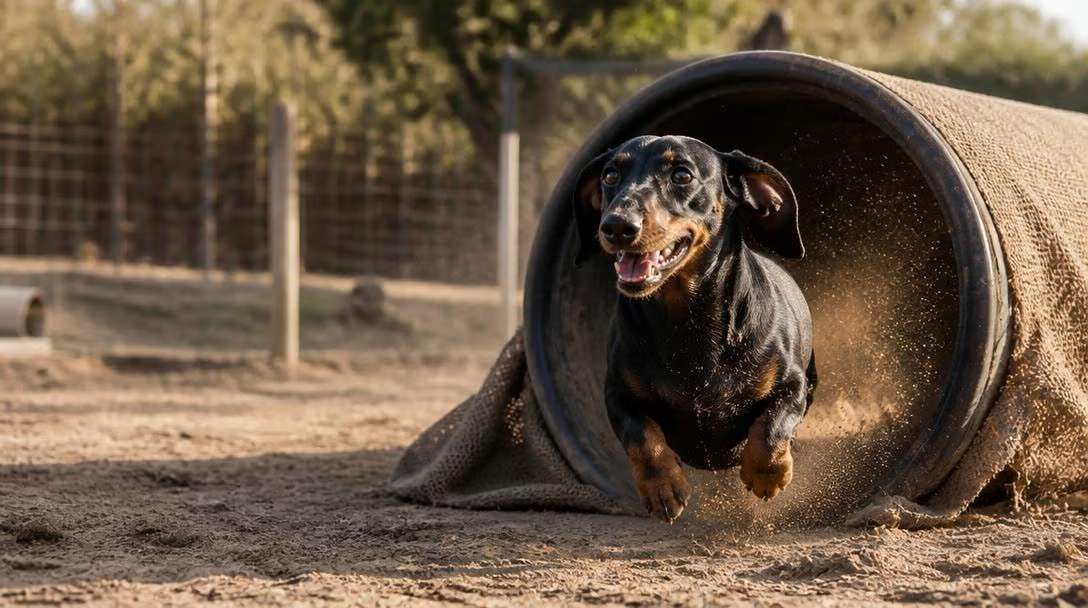
To understand why dachshunds take to certain sports so naturally, you have to go back to the job they were bred for. These dogs were developed in Germany to go underground after badgers — squeezing into tight dens, following scent in total darkness, and working independently to corner an animal many times their size. We’ve covered that origin story in detail in our full history of the breed, but the short version is this: your dachshund’s brain still expects a job that involves scent, tunnels, and persistence.
That heritage shows up as specific, predictable drives. Most dachshunds will follow an interesting smell well past the point a Labrador would’ve given up. Many of them genuinely enjoy tight, enclosed spaces instead of finding them stressful. And almost all of them have a stubborn, task-focused streak that can look like defiance on a leash but turns into real focus the moment there’s a clear goal in front of them. Dog sports built around scent and den work let that instinct do something useful instead of getting aimed at your closet or the gap under the fence.
Earthdog Trials: Where This Breed Was Born to Compete
If there’s one sport that feels custom-built for dachshunds, it’s earthdog trials. The American Kennel Club runs an Earthdog program specifically for small, scenting, “go-to-ground” breeds — dachshunds, terriers, and a handful of others whose entire original purpose was chasing quarry underground.
In a real trial, your dog works through a series of underground tunnels (built safely, with the quarry — usually rats — kept completely separated from the dog behind a secure barrier at all times) and has to locate and “work” the quarry by barking, scratching, or digging at the barrier. There are four titles, each harder than the last:
- Introduction to Quarry (optional, non-titling): a short, straight tunnel just to see if your dog is interested. This is where almost everyone starts.
- Junior Earthdog (JE): a simple tunnel with one turn, completed twice.
- Senior Earthdog (SE): longer, with multiple turns, a false exit, and the dog has to work independently without you nearby.
- Master Earthdog (ME): the full test — obstacles, distractions, another “non-working” dog in the mix, and the highest level of independent problem-solving.
What makes this such a good match for dachshunds specifically is that nothing about it fights the breed’s natural shape or instinct. There’s no jumping, no sharp pivoting, and no sustained running — just crawling, sniffing, and digging, which is exactly what a dachshund’s body and brain were designed to do well. Most local earthdog clubs run an “intro to quarry” day specifically so you can see your dog’s reaction before committing to formal training.
Barn Hunt: Scent Work With a Job Attached
Barn Hunt is a newer sport, but it borrows the same core idea: let a dog use its nose on live (safely caged) rats hidden in straw bales inside a ring. Your dog has to find all the hidden rat tubes within a time limit, and at higher levels, also climb over bales and navigate a tunnel built into the straw.
The rats are never in danger — they live in secure, ventilated PVC tubes that the dogs can smell but never reach, and most are retired from the program to live out their lives as pets once their “working” days are done. For the dog, it’s pure, structured scent work with a clear, satisfying payoff (loud alerting at a tube counts as a win), which plays to the same strengths as earthdog work without needing an actual dug-out tunnel system. It’s also a little gentler to get into — many Barn Hunt clubs are more casual and beginner-friendly than AKC conformation-adjacent sports, which makes it a good low-pressure entry point.
Agility — Only With the Right Modifications
Agility is where I’d ask you to slow down. Standard agility courses are built around jumping, tight weave poles, and fast directional changes — exactly the kind of repetitive spinal stress that raises the risk of intervertebral disc disease (IVDD) in a breed already prone to it. That doesn’t mean agility is off the table, but it means it needs real modification and a vet’s sign-off before you start.
Dachshund-friendly agility generally means jump heights set appropriately low for the dog’s size, weave poles either removed or set at a wider spacing designed for short-backed breeds, and a trainer who understands this breed’s specific risk profile rather than running them through a generic course built for border collies. Some dachshund owners skip formal AKC agility entirely and instead do “backyard agility” at a slow, controlled pace purely for enrichment, with no jumping at all. If your dog has ever shown signs of back sensitivity, or if you’re unsure where that line is, our guide to safe exercise for dachshunds with back problems is the right place to start before you look at any jump-based sport.
Lower-Impact Options: Nose Work, Tracking, and Scent Trials
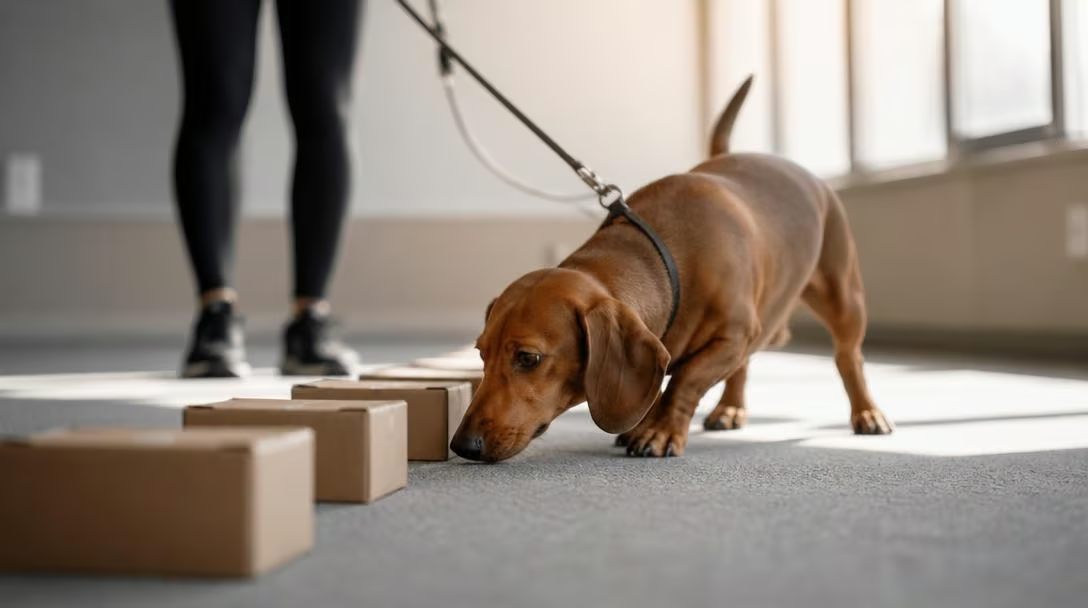
If your dachshund is older, recovering from a back issue, or you’d simply rather not introduce any jumping or climbing at all, there’s a whole category of sports built entirely around scent with zero impact on the spine. AKC Scent Work (sometimes still called “nose work” from its original program name) has your dog search a room, a row of containers, or an outdoor area for a hidden target odor, with no running, jumping, or climbing required at any level.
AKC Tracking is the outdoor cousin of this — your dog follows a specific scent trail laid across a field, sometimes hours earlier, to locate a dropped article at the end. Both of these are excellent choices for a senior dachshund who still has all the drive in the world but shouldn’t be doing anything that stresses the back, and they’re genuinely some of the most mentally exhausting work you can give a dog pound-for-pound. A 20-minute scent work session will tire out a dachshund’s brain more thoroughly than a much longer walk.
Is My Dachshund a Good Fit for Dog Sports?
Not every dachshund needs to compete, and not every dachshund should do every sport on this list. Before you sign up for anything, it’s worth running through a short mental checklist:
- Health first: get a vet check that specifically looks at back and joint health before starting anything with jumping, climbing, or sustained impact. A dog with any history of IVDD symptoms, patellar luxation, or hip issues needs a vet’s explicit go-ahead, and some dogs should stick to scent-only sports permanently.
- Age matters: puppies under about a year shouldn’t do jump-based activities at all while their growth plates are still developing, but scent games are safe and genuinely great for building focus early.
- Read the drive: does your dog light up around new smells, dig with enthusiasm, or get laser-focused tracking something across the yard? That’s your sign toward earthdog, Barn Hunt, or scent work. A dog that’s more interested in people and routine than independent problem-solving might prefer agility-lite or just structured play instead.
- Start low-stakes: almost every club runs an informal “fun match” or intro session before you commit to real training or entry fees. Use it. It tells you in one afternoon whether this is worth pursuing further.
How to Get Started
The easiest entry point for any of these is the AKC’s own club search tool, which lists Earthdog, Barn Hunt, Scent Work, and Agility clubs by region — most hold regular training days that welcome newcomers and mixed-breed or pet-only dogs, not just competition-bound purebreds with paperwork. Barn Hunt Association and the National Association of Canine Scent Work (NACSW) run their own independent club directories as well, and both tend to be especially welcoming to small, low-key breeds like dachshunds.
Whichever sport catches your interest, start with a single intro class or fun match before buying equipment or committing to a full training plan. It costs very little, takes an afternoon, and tells you more about your particular dog’s interest than any article — including this one — ever could.
Frequently Asked Questions
Can dachshunds really compete against bigger dogs in these sports?
In earthdog and Barn Hunt, dachshunds aren’t just competing against bigger breeds — they’re often the stars. Both sports are specifically built around small, scenting go-to-ground breeds, and a dachshund’s size and instinct are an advantage, not a handicap.
Is earthdog training dangerous for the “quarry” rats used in trials?
No. The rats stay in secure, ventilated enclosures the entire time and are never in physical contact with the dogs. Most are cared for long-term by the clubs that run the trials rather than being used once and discarded.
At what age can I start my dachshund in dog sports?
Scent-based activities like nose work and introductory earthdog tunnels are generally safe to start young, often under a year old, since they involve no jumping or spinal stress. Anything involving jumping or sustained impact, including agility, should wait until a vet confirms your dog’s growth plates have closed and their back is healthy.
My dachshund has had back problems before — are any sports still safe?
Yes. Scent Work and Tracking involve no jumping or climbing and are generally considered safe even for dogs managing a history of back issues, though you should always get a current vet opinion first. Earthdog and Barn Hunt involve some crawling and digging, which is usually fine, but ask your vet about your dog’s specific situation before enrolling.
Do I need a purebred, registered dachshund to compete?
Not for most of these. AKC Earthdog, Barn Hunt, and Scent Work all offer programs for mixed-breed dogs, and many clubs run informal fun matches open to any dog regardless of papers. Full AKC conformation-adjacent titling in some events may require registration, but plenty of the sport itself is open to every dog.
Find the Sport That Fits Your Dog
The through-line in everything above is this: a dachshund that seems impossible to tire out at home often isn’t lazy, bored, or being difficult — it’s just missing the kind of work its brain was built for. Whether that ends up being a weekend earthdog trial, a Barn Hunt ring, or a slow Sunday afternoon of nose work in your backyard, almost every dachshund has a version of “sport” that fits them. Start with a fun match, watch how your dog reacts, and let that tell you where to go from there.


