
Every few weeks I get a version of the same question from a reader: “Hank, is it okay to bring my dachshund to the dog park, or is that a bad idea for a breed built like this?” It’s a fair thing to wonder. Dog parks are free, they’re social, and on paper they look like the easiest way to burn off a little energy. But a dachshund isn’t built like most of the dogs you’ll meet there, and that changes the math in a few important ways.
This isn’t a “never go” guide. Plenty of dachshunds have a great time at the right dog park, played the right way. It’s a “know what you’re walking into” guide — the real risks, how to read your dog once you’re there, and how to make the visit safer if you decide it’s worth it.
Why Dog Parks Are Trickier for Dachshunds Than Most Breeds
Most dog park advice is written for an average-sized, average-risk dog — something in the 30- to 60-pound range that can hold its own in a wrestling match. A dachshund is a different animal, almost literally. A miniature might weigh 10 pounds soaking wet; even a standard rarely tops 32. That size difference alone changes how every interaction at the park plays out.
Then there’s the build. Dachshunds carry a long spine over short legs, and that spine is genuinely more vulnerable to injury than a typical dog’s — intervertebral disc disease (IVDD) is a well-documented risk for the breed, and it doesn’t take a dramatic accident to trigger a flare-up. A hard body-check from a bigger dog, an awkward twist while being chased, or even being picked up wrong by a well-meaning stranger at the park can be enough. If you haven’t read it yet, my guide on safe exercise for dachshunds with back problems goes into exactly which movements put the most strain on that spine — it’s worth knowing before you’re standing in a crowded park deciding whether to let your dog join a game of chase.
The Real Risks: What Can Actually Go Wrong
None of this means a dog park is automatically dangerous. It means the odds of something going sideways are a little higher for a dachshund than for a mid-sized dog, so it’s worth knowing exactly what you’re watching for.
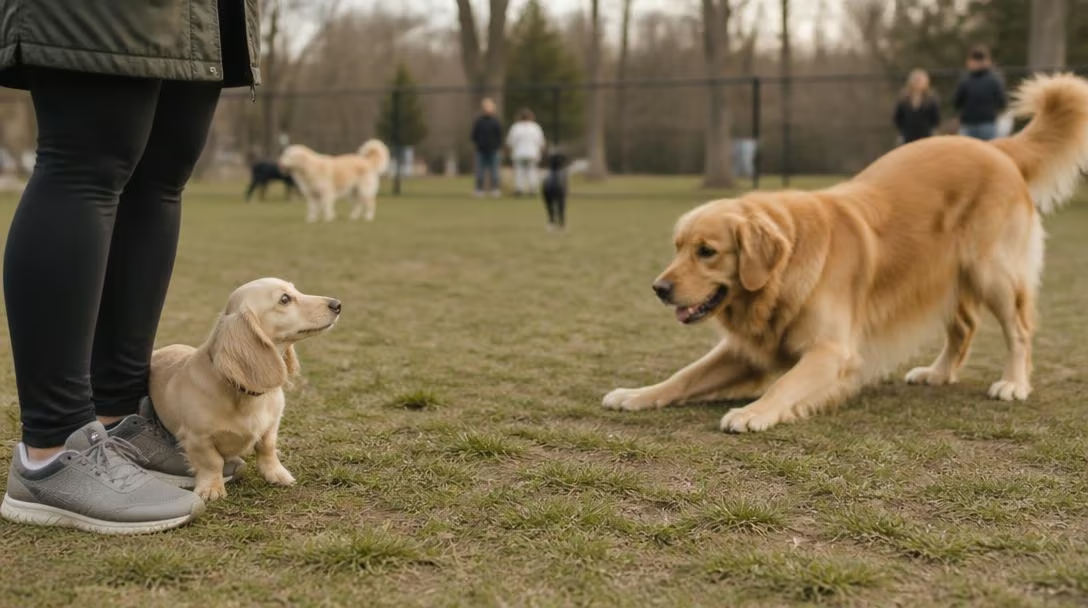
- Size-mismatch injuries. The single biggest risk at an all-breed dog park is simple physics — a 60-pound dog playing normally, not even aggressively, can knock a dachshund off its feet or step on it during a group chase. That kind of impact is exactly what a long, low spine doesn’t handle well.
- Rough or one-sided play. Some dogs play by pinning, mouthing at the neck, or standing over a smaller dog. A Labrador or a herding breed might read this as normal rough-housing; for a dachshund, being pinned or rolled awkwardly is a real injury risk, not just an unpleasant moment.
- Predatory drift. This is the uncomfortable one: in rare cases, a small, fast-moving dog running with a pack of larger dogs can trigger a chase instinct that tips from play into something more serious. It’s uncommon, but it’s the scenario experienced trainers and vets specifically warn small-breed owners to watch for.
- Heatstroke and overexertion. Dachshunds run close to the ground, which means they’re closer to hot pavement and reflected heat than a tall dog is. On warm days, a dog park visit can tire out and overheat a dachshund faster than you’d expect.
- Parasites and shared water bowls. Standard outdoor-space risks — fleas, ticks, giardia from a communal water bowl — apply to every breed, but a dachshund’s low build means more direct contact with grass, dirt, and whatever the last dozen dogs tracked through.
A quick body-condition check matters here too. A dachshund already carrying extra weight is at higher risk for both back injury and overheating during active play — my weight management guide has a simple way to check where your dog actually stands.
Reading the Room: Is Your Dachshund Actually Having Fun?
The most useful skill you can bring to a dog park isn’t a product or a piece of gear — it’s knowing how to read your own dog. Dachshunds are expressive, but their signals get missed easily in a noisy, crowded park.
Good signs: loose, wiggly body language, a relaxed open mouth, play-bowing (front end down, back end up), voluntarily returning to the action after a break, and taking breaks at all. A dachshund who’s genuinely enjoying himself will check back in with you periodically, not just run the whole time in a straight line away from you.
Warning signs: a stiff, frozen body, tail tucked tight, ears pinned flat, lip-licking or excessive panting with no exertion to explain it, trying to hide behind your legs, or snapping when approached. Any one of these means it’s time to leash up and head out — not to “let him work it out.” I go into a lot more detail on what normal versus stressed body language actually looks like in my guide to understanding dachshund behavior, and it’s genuinely useful reading before your first park visit, not just after something goes wrong.
Small-Dog Areas vs. All-Size Dog Parks
If your local park has a separate small-dog section — usually fenced off and limited to dogs under 25 or 30 pounds — that’s almost always the better choice for a dachshund, standard-sized or miniature. It doesn’t eliminate every risk (a boisterous 25-pound terrier can still bowl over a 10-pound mini), but it removes the single biggest one: a massive size mismatch.
If your only option is an all-size park, go in with a plan rather than just letting your dog off the leash and hoping for the best. That plan is the next section.
Making a Dog Park Visit Safer
A few habits make a real difference in how safely a dog park visit goes, especially for a breed with this particular build.
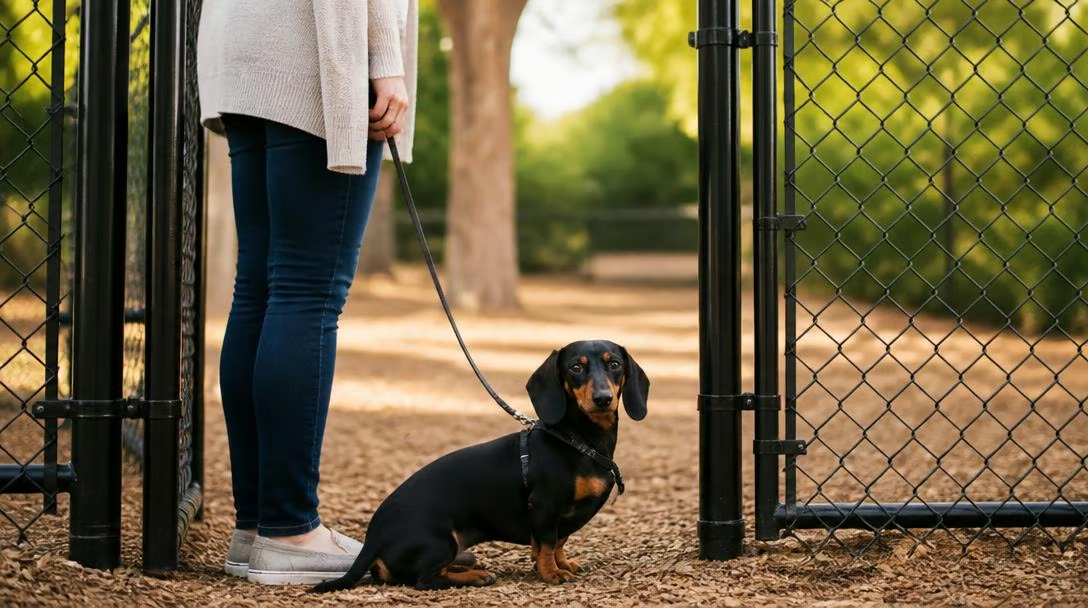
- Go at off-peak times. A quiet park with three or four calm dogs is a completely different experience than a packed Saturday-morning park with twenty. Fewer dogs means fewer chances for a chaotic group chase to start.
- Watch the gate, not just the field. Most conflicts start in the first thirty seconds after a new dog enters, when everyone rushes to greet them at once. Stand near your dog during that window rather than drifting off to chat.
- Keep sessions short. Fifteen to twenty minutes of real play is often plenty — long enough to be worthwhile, short enough that fatigue and heat don’t start working against you.
- Know the other dogs before you commit. If a dog is playing rough with everyone, or the owner is clearly not paying attention, that’s your cue to move to another part of the park or call it a day.
- Skip jumping and height-based play. Fetch that involves your dog leaping for a ball, or play that has your dachshund standing up on hind legs against another dog, puts unnecessary strain on that long spine. Keep the fun low to the ground.
- Introduce dog parks early and gradually, if you can. A dachshund who was well socialized as a puppy generally reads other dogs’ signals better and recovers from a startling moment faster. My puppy socialization guide covers the critical window for building that confidence, and it pays off for years at places exactly like the dog park.
When to Skip the Dog Park Altogether
Some dogs are better served by a different kind of exercise entirely, and there’s no shame in making that call. Consider skipping the dog park if your dachshund has a diagnosed back condition or a recent IVDD episode, has shown reactive or fearful behavior around unfamiliar dogs, is still too young to be fully vaccinated, or is a senior with mobility or vision changes that make a crowded, unpredictable environment stressful rather than fun. If aggression or fear-based reactivity is part of the picture, it’s worth working through my guide on dachshund aggression — and ideally a session with a trainer — before putting your dog in a group setting at all.
Alternatives That Give You the Same Benefits
If a dog park isn’t the right fit, your dachshund can still get plenty of exercise and social time without the size-mismatch risk. A one-on-one playdate with a dog you already know and trust gives most of the social benefit with none of the chaos. A supervised, flat, dachshund-safe trail walk — see my hiking and trail safety guide for what to look for in a good route — covers the exercise side just as well. And on days when getting outside isn’t practical, a good indoor enrichment session can be surprisingly tiring in its own right.
Frequently Asked Questions
Can dachshunds go to dog parks at all?
Yes, for most healthy, well-socialized dachshunds, a dog park visit can be perfectly safe — especially in a small-dog area, during quieter hours, with an owner actively supervising. The key is matching the environment and the play style to your individual dog rather than assuming every park is equally appropriate.
Are small-dog dog park areas actually safer?
Generally, yes. Removing large-breed dogs from the equation eliminates the biggest single risk factor — a serious size mismatch during play. It’s not a guarantee of zero conflict, since small dogs can still play roughly with each other, but it meaningfully lowers the odds of a real injury.
At what age can a dachshund puppy go to a dog park?
Most vets recommend waiting until a puppy has completed their full vaccination series, typically around 16 weeks, before visiting a public dog park where exposure to unknown dogs’ health and vaccination status can’t be controlled. Early, careful socialization with known, healthy dogs is a safer way to build social skills before that point.
How do I know if my dachshund is too stressed to stay at the park?
Watch for a stiff or frozen posture, a tightly tucked tail, flattened ears, excessive panting without exertion, or attempts to hide behind you. Any of these is a clear signal to leash up and leave — pushing through it rarely helps and can make the next visit harder, not easier.
Can a dog park visit cause a back injury in a dachshund?
It can, usually indirectly — through a hard collision with a larger dog, an awkward fall, or being picked up incorrectly mid-play rather than from running itself. Supervising play closely and steering your dog away from rough games is the best prevention.
The Bottom Line
A dog park isn’t off-limits for a dachshund, but it does deserve a little more thought than it would for a sturdier, mid-sized breed. Pick the right time, the right section of the park if one’s available, keep sessions short, and pay attention to what your dog’s body language is actually telling you. Do that, and a dog park can be a genuinely good source of exercise and socialization rather than a gamble.


