
If there’s one thing I wish every dachshund owner understood before they brought their puppy home, it’s this: the personality your dog has at two years old is being built right now, in these first few months. I’ve worked with hundreds of dachshunds over the years, and I can almost always tell within the first five minutes of meeting an adult dog whether they got solid socialization as a puppy. The confident, friendly ones who greet strangers with a wagging tail and take a garbage truck rumbling by in stride? Someone put in the work early. The ones who bark and lunge at every dog on the sidewalk or cower behind their owner’s legs at the vet? Usually, that critical window got missed.
Dachshunds are wonderful, but they didn’t get bred to be easygoing. This is a breed built to go underground after badgers alone, which means centuries of selecting for independence, boldness, and a “handle it myself” attitude. That’s a fantastic trait in a hunting dog and a genuinely tricky one in a family pet if it isn’t shaped in the right direction early on. Socialization is how you shape it. Let’s talk about how to do it right.
What Socialization Actually Means (It’s Not Just “Meeting Other Dogs”)
A lot of new owners hear “socialization” and think it means dog parks and puppy playdates. That’s part of it, but it’s a small part. Real socialization is about exposing your puppy to the full range of people, animals, sounds, surfaces, and situations they’ll encounter as an adult dog, in a way that teaches them “this is normal, this is safe” rather than “this is scary.”
Think of it as building a mental filing cabinet. Every new experience your puppy has during this window gets filed away as either “fine” or “threat.” A puppy who meets twenty different kinds of people, hears a vacuum, rides in a car, walks on grass and tile and gravel, and gets handled gently by a stranger during this window files almost everything under “fine.” A puppy who spent those same weeks mostly at home with the same two people files almost everything outside that bubble under “unknown,” and unknown, to a dog, often defaults to “threat.”
The Critical Window: Why Timing Matters More Than Anything Else
Puppies have a genuine biological window for this kind of learning, and it closes. Most veterinary behaviorists put the primary socialization period at roughly 3 to 14 weeks of age, with the most important stretch falling between 7 and 12 weeks — right around when most people are bringing their dachshund puppy home. After about 14 to 16 weeks, the window doesn’t slam shut entirely, but a puppy’s brain shifts from “everything new is worth investigating” to “everything new should be treated with caution” as a survival instinct. That doesn’t mean an older puppy or adult dog can’t learn to be comfortable with new things — they absolutely can, with patient counter-conditioning — but it’s slower, harder work than it needs to be if you catch the window while it’s open.
This is also where the vaccination timing question comes up, and it trips up a lot of new owners. Puppies typically aren’t fully vaccinated until around 16 weeks, which lands right at the end of the ideal socialization window. The American Veterinary Society of Animal Behavior’s official position is that the risk of a puppy developing serious, permanent behavioral problems from under-socialization outweighs the relatively low risk of disease exposure during this period, provided you’re smart about it. That means controlled exposure — carrying your puppy through a busy parking lot instead of setting them on the ground, hosting a puppy playdate in your own yard instead of the dog park, going to puppy classes that require proof of first vaccinations rather than unrestricted off-leash areas — rather than skipping socialization until vaccines are complete.
The Dachshund-Specific Reason This Matters So Much
I mentioned the breed’s independent streak already, but there’s a second piece that makes socialization especially important for dachshunds: their small size makes it genuinely easy for owners to accidentally reinforce fearful or defensive behavior without meaning to. When a Labrador puppy barks at something scary, most owners work through it. When a dachshund puppy does the same thing, it’s easy to scoop them up, coo at them, and carry them away — which, from the dog’s perspective, confirms that the scary thing really was worth reacting to, and that reacting gets them rescued. Over months and years, this pattern is a big part of why small dogs in general, and dachshunds in particular, end up with a reputation for being snappy or reactive. It’s rarely genetics. It’s usually an under-socialized puppy whose fear responses got unintentionally rewarded instead of gently worked through.
If reactivity does take hold, it can turn into a real problem — I’ve written a full guide on recognizing and correcting dachshund aggression if you’re already seeing warning signs in an older puppy or adult dog. But the honest truth is that prevention here is so much easier than the fix. Good socialization is the single best insurance policy against needing that article later.
Building a Socialization Checklist: The Categories to Cover
Rather than thinking of socialization as one task, break it into categories and aim to check off a handful of experiences in each one every week during the window. Here’s the list I give every dachshund owner I work with:
- People: Adults of different heights, people wearing hats and sunglasses, people with beards, children of different ages, people using wheelchairs or walkers, delivery workers in uniform.
- Other animals: Calm, vaccinated adult dogs of different sizes (always supervised), cats if possible, and — from a distance, just as an observed experience — livestock or other animals your puppy might encounter later.
- Sounds: Vacuum cleaners, doorbells, thunder recordings, traffic noise, garbage trucks, fireworks recordings played at low volume, other dogs barking.
- Surfaces and environments: Grass, gravel, tile, hardwood, metal grates, elevators, stairs, car rides, vet clinic waiting rooms (even just for a treat and a “hello,” not always an exam).
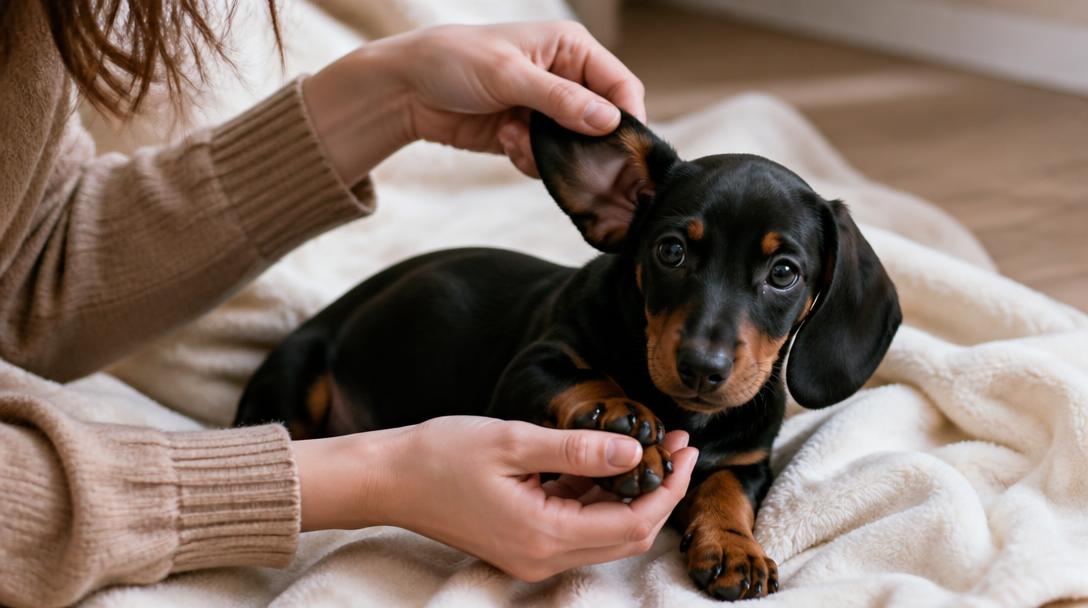
- Handling: Having paws touched, ears checked, mouth opened gently, being toweled off, nail trims (or at least the clipper being present and rewarded) — this pays off enormously at grooming and vet visits down the line.
- Objects: Umbrellas opening, bags rustling, bicycles and skateboards passing, balloons, the vacuum sitting turned off before it’s turned on.
You don’t need to check every box in week one. A good rule of thumb is a handful of new, positive exposures per day, kept short and always ending before your puppy gets overwhelmed. Quality and a calm ending matter far more than quantity.
How to Introduce Something New the Right Way
The mechanics matter as much as the exposure itself. A puppy who gets dragged toward something scary, or flooded with too much at once, can actually become more fearful of it — the opposite of what you’re going for. Here’s the pattern that works:
- Let your puppy set the pace. Approach new things at a distance where your puppy is curious or neutral, not panicked. If they’re pulling away or trying to hide, you’re too close — back up.
- Pair it with something good. Treats, a favorite toy, or calm praise the moment your puppy notices the new thing. You’re building an association: new thing appears, good stuff happens.
- Never force contact. Let your puppy approach a new person or dog on their own terms. Forcing an interaction (physically pushing a puppy toward a stranger’s outstretched hand, for example) can backfire badly.
- End on a good note. Wrap up the exposure while your puppy is still comfortable, not after they’ve become overwhelmed. Better to do five short, successful sessions than one long one that goes sideways.
Puppy Classes and Playdates: What to Actually Look For
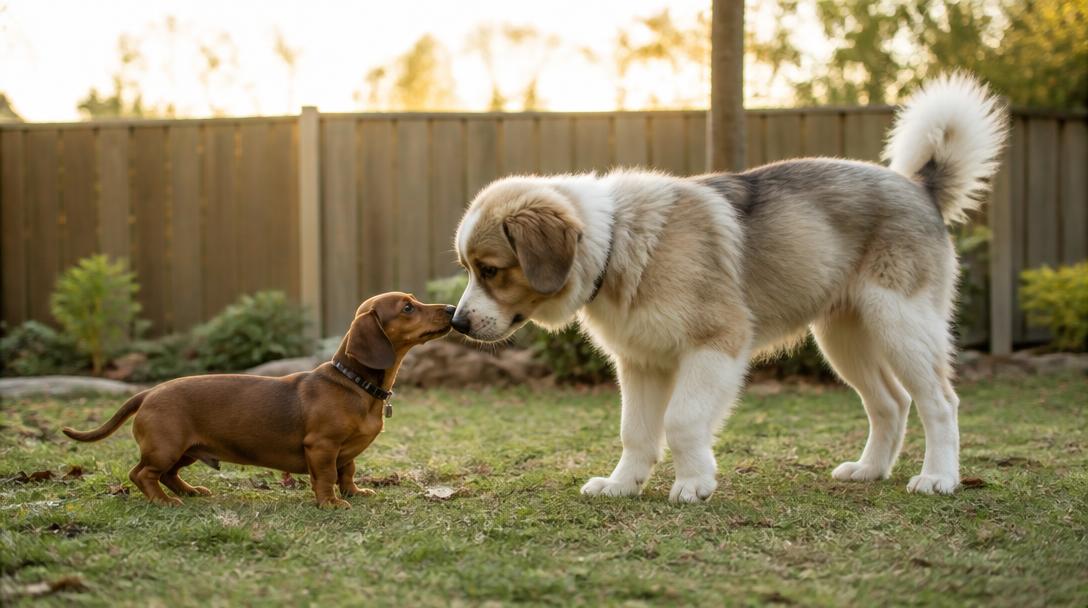
A good puppy socialization class is genuinely one of the best investments you can make in these early weeks — but not all of them are created equal. Look for a class that requires proof of first vaccinations and a health check before enrollment (this is what makes it safer than an open dog park), keeps group sizes small, and separates puppies by size and play style rather than tossing everyone into one free-for-all. Because of the size gap, I’d rather see a dachshund puppy playing with a calm, appropriately-sized playmate than getting bowled over by an enthusiastic 60-pound Labrador puppy — one bad experience with a boisterous larger dog during this window can create a lasting fear of big dogs. If your trainer can’t tell you how they manage size and temperament mismatches in a mixed class, ask more questions before signing up.
Don’t Skip the Confidence-Building Side of Play
Socialization isn’t only about exposure to scary things — it’s also about building genuine confidence, and that includes safe, appropriate play. One thing I ask every dachshund owner to keep in mind here: because of this breed’s long back and real risk of intervertebral disc disease (IVDD) later in life, keep puppy play sessions on the gentler side. Avoid letting your puppy be repeatedly picked up and dropped by bigger dogs during play, discourage jumping on and off furniture, and use a ramp or supported lift for anything higher than a low step. Building confidence and protecting that back can absolutely happen at the same time — they’re not in conflict, but it does mean supervising play a little more closely than you might with a sturdier breed.
If you haven’t already worked through the basics of house manners and foundational cues, my complete guide to training a dachshund puppy is a good companion piece to this one — socialization and foundational training go hand in hand during these same early months.
What If You’re Starting Late?
If your dachshund is already past 16 weeks and you’re realizing the socialization window has mostly closed, don’t panic — and don’t skip the rest of this article. Older puppies and adult dogs can still make real progress with new people, dogs, and situations. It just takes a different approach: slower introductions, more patience, and often the help of a certified trainer or veterary behaviorist using structured desensitization and counter-conditioning rather than simple exposure. The goal shifts from “prevent fear from forming” to “gradually replace an existing negative association with a positive one,” which is a longer process but a genuinely achievable one for most dogs.
Frequently Asked Questions
What age should I start socializing my dachshund puppy?
As early as possible — ideally starting the moment you bring your puppy home, typically around 8 weeks. The primary window runs roughly 3 to 14 weeks, so every week counts, and there’s no benefit to waiting until vaccinations are fully complete.
Is it safe to socialize my puppy before they’re fully vaccinated?
Yes, with reasonable precautions. Carry your puppy in high-traffic public areas instead of letting their paws touch the ground, choose puppy classes that require proof of first vaccinations, avoid dog parks and areas with unknown dogs, and favor controlled settings like a friend’s yard with a known, healthy, vaccinated dog. Most veterinary behaviorists consider this a safer trade-off than delaying socialization entirely.
My dachshund puppy seems scared of everything all of a sudden. Is that normal?
Likely yes — dachshunds typically go through a “fear period” around 8 to 11 weeks, and sometimes a second one during adolescence (roughly 6 to 14 months), where things they were previously fine with suddenly spook them. Don’t force interactions during this phase; keep exposures gentle and positive, and it usually passes within a couple of weeks.
How do I socialize my dachshund with other dogs without a dog park?
Set up one-on-one playdates with calm, vaccinated, known dogs, ideally of a similar size and play style. A properly run puppy class with small, size-matched groups is also excellent. True dog parks are actually one of the riskier socialization tools for a young or small dog — unpredictable dogs, no size matching, and no supervision structure.
Can I socialize my dachshund too much?
You can overwhelm a puppy in a single session by pushing too far, too fast, but you can’t “over-socialize” in the sense of giving them too many varied, positive experiences over time. If your puppy is showing signs of stress — yawning, lip licking, tucked tail, trying to retreat — that’s a signal to slow down and shorten sessions, not a sign to stop socializing altogether.
The Payoff Is Worth It
Socialization during these early weeks is genuinely one of the highest-leverage things you’ll do for your dachshund’s entire life. It’s a few months of intentional effort in exchange for years of having a dog who can handle the vet, the groomer, house guests, and a walk down a busy street without stress. If you’re still in the middle of this window, prioritize it — the effort you put in now is effort you won’t have to spend untangling fear and reactivity later.