
There’s a conversation almost every dachshund owner eventually has with themselves, usually late at night after watching their old friend struggle to get comfortable for the third time in an hour. It’s the quiet question: is he still having good days, or am I just hoping he is? I’ve sat with a lot of families in exactly that spot, and I want to walk you through how to actually answer that question instead of just feeling your way through it.
This isn’t a cheerful topic, and I’m not going to pretend it is. But knowing how to honestly assess a senior dachshund’s quality of life is one of the most important things you can do for a dog who has spent a decade or more trusting you completely. Doing it well means fewer regrets later, and more good days now.
What “Quality of Life” Actually Means
Quality of life isn’t a single yes-or-no switch that flips on a bad day. It’s a pattern you track over time, across a handful of specific areas of your dog’s daily experience. Veterinary hospice programs use structured scoring tools for exactly this reason — because in the moment, emotions make it almost impossible to see the pattern clearly. You remember the one good hour and forget the six hard ones, or the reverse.
The areas that matter most, and that I ask owners to track honestly, are:
- Pain and comfort — is pain controlled with the medications and support you’re already using, or is your dog showing signs of discomfort (panting at rest, reluctance to be touched, restlessness) even with treatment?
- Appetite and hydration — is your dog still interested in food and water, or are you having to coax, hand-feed, or syringe-feed most meals?
- Hygiene and mobility — can your dog get up, reposition, and get outside (or to a pad) to relieve themselves without prolonged struggle or soiling themselves?
- Happiness and engagement — does your dog still show interest in the things that used to bring them joy — greeting you at the door, watching the window, a favorite toy — or has that spark mostly gone quiet?
- More good days than bad — when you look back honestly over the last one to two weeks, which column has more entries?
No single bad afternoon means it’s time. What matters is the trend across all five areas, tracked over days and weeks, not hours.
Dachshund-Specific Signs Worth Watching Closely
Because of the breed’s long spine and short legs, dachshunds tend to decline in a few particular ways that are worth knowing ahead of time, so you’re not caught off guard by them.
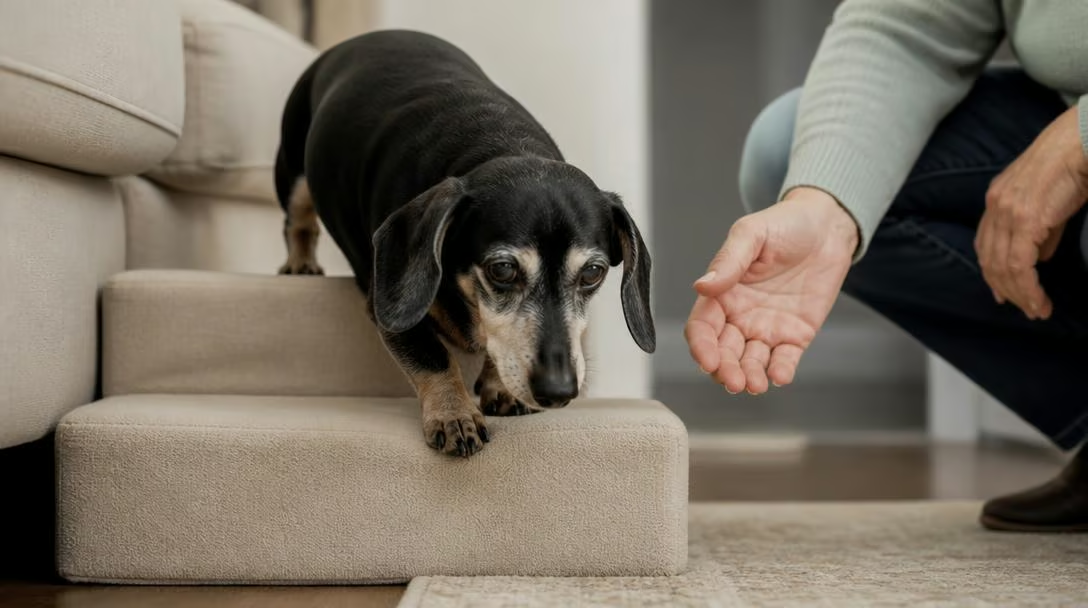
Back and mobility changes often lead the way. A dog who has lived with IVDD risk their whole life may start showing more frequent “bad back days,” slower rises from lying down, or reluctance to use stairs or furniture they used to handle easily. This is different from a single flare-up — it’s a steady narrowing of what your dog can comfortably do. If mobility has become a daily struggle rather than an occasional one, it’s worth revisiting pain management and home modifications with your vet (our senior home safety guide covers ramps and traction fixes that can buy real quality-of-life time before things reach a crisis point).
Incontinence is another one that sneaks up gradually and then becomes constant. Occasional accidents are manageable and don’t by themselves signal anything dire — see our guide to senior incontinence for ways to manage it. But when soiling becomes near-constant despite management, and your dog seems distressed by it (rather than simply unaware), that’s a meaningful hygiene and dignity concern worth weighing seriously.
Cognitive changes matter too, and they’re easy to write off as “just getting old.” A dachshund with worsening canine cognitive dysfunction may seem confused, disoriented in familiar spaces, or disconnected from the people and routines that used to anchor their day. If you haven’t already, it’s worth reading up on what’s actually happening neurologically — it reframes a lot of behavior that otherwise just looks like your dog “isn’t himself anymore.”
The “More Good Days Than Bad” Rule
If you take away one practical tool from this guide, make it this: keep a simple daily log. A notebook on the fridge, a notes app, even a calendar with a quick “good” or “hard” marked each evening works. After a week or two, step back and count.
Hospice veterinarians rely on this because it strips out the emotional noise of any single bad hour and shows you the actual trajectory. A dog having four hard days out of fourteen is in a very different place than a dog having ten hard days out of fourteen, even if both of those weeks included one particularly rough afternoon that scared you. The log also gives you something concrete to bring to your vet, rather than trying to summarize weeks of gradual change from memory in a ten-minute appointment.
Watch especially for days where pain breaks through your current medication plan, where your dog refuses food they’d normally want, or where they seem to actively withdraw from you rather than just resting. Those are the entries that tend to cluster together as decline accelerates.
Talking It Through With Your Veterinarian
This is not a decision to make alone from internet research, and I say that as someone whose whole job is giving you internet research. Your vet has seen your dog’s bloodwork, their mobility in the exam room, and their specific diagnoses, and can tell you what’s realistically treatable versus what’s now part of a permanent decline.
Bring your daily log. Ask directly: “Based on what you’re seeing, do you think his quality of life can still be meaningfully improved, or are we managing a decline that medication and supportive care can only slow?” Good veterinarians are used to this exact conversation and will give you an honest answer rather than a vague one, if you ask directly for one.
It’s also worth asking whether a veterinary hospice or in-home palliative care service operates in your area. These services specialize in exactly this phase — helping you keep a dog comfortable at home for as long as that’s genuinely possible, and helping you recognize clearly when it isn’t anymore.
Making Their Remaining Time Count
Once you’re in this phase, the goal shifts from “treating toward recovery” to “maximizing comfort and connection.” That can look different for every dog, but a few things tend to help across the board: keeping their environment as calm and familiar as possible, allowing them to rest somewhere warm and supportive near the family rather than isolated, and favoring short, easy pleasures — a favorite food, a gentle backyard sniff in the sun, time on your lap — over anything demanding.
This is also the time to let go of routines that no longer serve your dog. If stairs have become a daily source of pain, carry them. If a long walk is no longer enjoyable, a slow five minutes of sniffing the yard is plenty. Comfort takes priority over habit.

Many owners find it helps to mark this time deliberately — a special photo, a slower morning together, a last visit somewhere they loved. There’s no right way to do this. The only wrong way is to let guilt about “not doing enough” crowd out the time you do have.
Frequently Asked Questions
How do I know if my dachshund is in pain I’m not recognizing?
Dogs, and dachshunds especially, are often stoic about pain. Watch for subtler signs: panting at rest, reluctance to be picked up or touched in certain spots, restlessness or trouble settling, a hunched posture, or decreased interest in things they normally enjoy. If you suspect pain your current plan isn’t controlling, it’s always worth a vet check rather than assuming it’s just “old age.”
Is it normal for quality of life to go up and down before the final decline?
Yes, and this is exactly why tracking over one to two weeks matters more than any single day. Many senior dogs have genuine good stretches mixed in with harder patches, sometimes for months, before a clearer and more consistent decline sets in.
Should I wait until my dachshund stops eating entirely before considering euthanasia?
No — appetite loss is one sign among several, not the deciding factor on its own, and waiting for every sign to be present at once often means waiting well past the point of real suffering. The combined pattern across pain, mobility, hygiene, and happiness matters more than any single symptom.
What is veterinary hospice care, and is it available for dogs?
Veterinary hospice (sometimes called pawspice) focuses on comfort and quality of life rather than curative treatment, often provided in your home. Availability varies by region, but many areas now have mobile vets or hospice-specific services — ask your regular vet for a referral if you think it could help.
You Know Your Dog Best
No guide, scale, or article can make this decision for you — what it can do is give you a clearer, calmer way to see what’s actually happening, instead of being swept along by fear or guilt in either direction. Track the pattern honestly, lean on your vet, and trust that a decision made from love and careful attention, even when it’s the hardest one you’ll ever make for your dog, is the right kind of decision.


