
“Is she losing her hearing, or is she just ignoring me?” I get some version of that question in nearly every senior wellness visit, usually said half-joking but with real worry underneath. As our resident healthcare specialist, I want to be straight with you: by the time most dachshunds reach eight or nine, some degree of vision and hearing decline is simply part of getting older — and it rarely shows up as a sudden, obvious event. It creeps in over months, which is exactly why so many owners miss the early signs or chalk them up to stubbornness.
The good news is that sensory decline in senior dachshunds is almost always manageable, and in many cases barely slows a dog down once you know what’s happening and adjust your home and routines accordingly. Let’s go through why it happens, what to watch for, and how to keep your senior dachshund confident and comfortable as their eyes and ears change.
Why Senior Dachshunds Lose Vision and Hearing
Most age-related sensory loss comes down to ordinary wear on tissue that’s been working for a decade or more. In the eyes, the lens gradually becomes denser and takes on a hazy, bluish-gray cast — a completely normal change called nuclear (lenticular) sclerosis that affects vision only mildly, if at all. In the ears, the delicate hair cells inside the inner ear that detect sound wear down over time, a process similar to age-related hearing loss in people. Neither process is a disease on its own; both are simply what aging tissue does.
Dachshunds do carry a bit of extra genetic baggage on the eye side, though. The breed has a documented predisposition to true cataracts (a denser, whiter clouding of the lens that does impair vision, unlike ordinary sclerosis) and to progressive retinal atrophy (PRA), an inherited condition where the light-sensing cells in the retina slowly deteriorate, usually starting with night vision and progressing from there. Responsible breeders screen for both, but because PRA can take years to show symptoms, it sometimes isn’t apparent until a dog is well into its senior years. Separately, dachshunds with the dapple (merle) pattern — especially “double dapples,” which inherit the dapple gene from both parents — can be born with congenital vision and hearing deficits tied directly to that coat genetics, which is a different issue entirely from the gradual, age-related decline this article focuses on. If you have a double dapple dachshund with lifelong sensory differences, your vet’s approach will look a bit different from what’s covered here.
Early Signs of Vision Loss in Senior Dachshunds
Dogs compensate for vision loss so well that owners often don’t notice until the decline is fairly advanced. Watch for:
- Hesitating at the top of stairs or the edge of furniture, especially somewhere they used to move confidently
- Bumping into furniture that hasn’t moved — particularly in dim light or an unfamiliar room, like a hotel room or a relative’s house
- A new reluctance to jump onto the couch or bed, separate from any back or joint pain
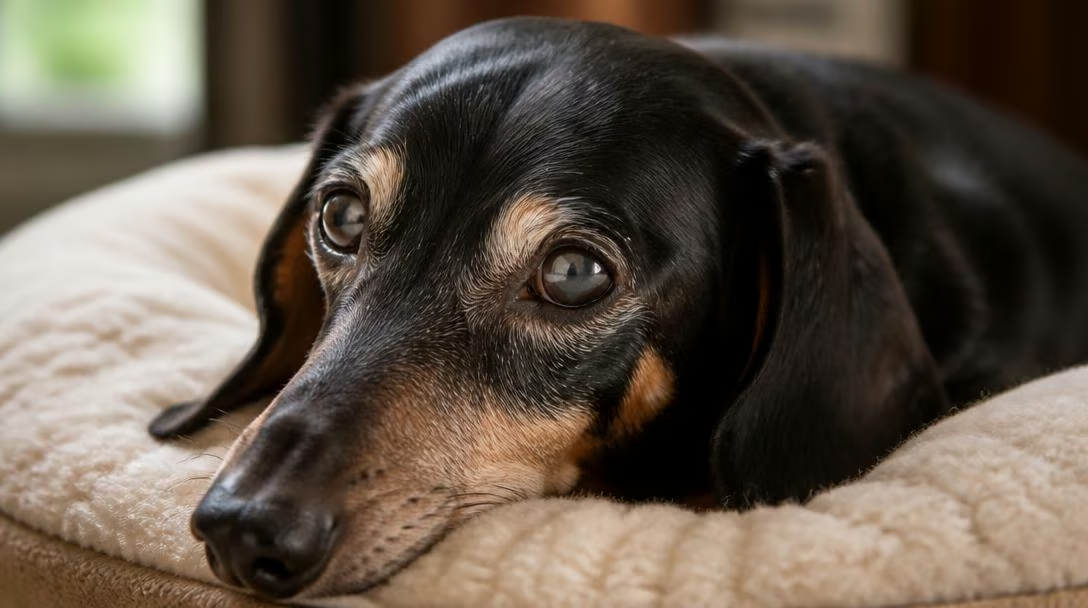
- A visible cloudy, bluish-white, or pearly tint to one or both eyes
- Startling when you approach from the side rather than head-on, since peripheral vision often goes first
- More clinginess or sticking closer to your legs on walks than they used to
A quick way to get a rough sense of changes at home: watch how your dog navigates a room with the lights dimmed versus fully lit. A dog losing night vision first (classic for PRA) will often move confidently in daylight but noticeably more cautiously at dusk or in a dark hallway.
Early Signs of Hearing Loss in Senior Dachshunds
Hearing loss gets misread as defiance more than almost any other senior symptom I see. Common signs include:
- Not responding to their name when you’re out of their line of sight, even though they clearly heard it fine a year ago
- Sleeping through sounds that used to wake them instantly — the doorbell, another dog barking, you coming home
- Startling or snapping when woken by touch rather than sound, simply because they didn’t hear you approach
- Barking more than usual, or in a flatter, louder tone — some dogs raise their own volume once they can’t hear themselves well
- Watching your face and hands more intently, which is often a dog quietly shifting to reading visual cues instead of verbal ones
If you suspect hearing loss, a simple at-home check is to make a noise your dog can’t see coming — a soft clap or a cabinet closing — while they’re facing away and not expecting it. Repeat it a few different ways over a few days rather than drawing conclusions from one test; dogs can be inconsistent, especially if they’re distracted or in a deep sleep cycle (which also becomes more common with age).
Getting a Proper Diagnosis
Home observation is useful for raising a flag, but I always recommend a proper exam rather than guessing. For vision, your vet can distinguish ordinary nuclear sclerosis from true cataracts or PRA with a focused light exam, and can refer you to a veterinary ophthalmologist for a full retinal evaluation if PRA is suspected — early diagnosis matters most for planning ahead, since PRA itself currently has no cure. For hearing, a BAER (brainstem auditory evoked response) test can objectively measure hearing in each ear, though in practice most senior hearing loss is diagnosed through history and simple in-clinic sound response checks rather than a formal BAER test. Either way, a wellness visit (see our full guide on routine dachshund veterinary care) is the right first step whenever you notice a change — partly to confirm what’s happening, and partly to rule out anything more urgent.
One important flag: gradual decline over months is typical aging. Sudden vision loss — your dog going from seeing fine to bumping into everything within a day or two — is not typical aging and needs an urgent vet visit. Sudden Acquired Retinal Degeneration Syndrome (SARDS) and acute glaucoma are two conditions that can cause rapid, sometimes permanent vision loss, and outcomes are generally better the sooner they’re caught.
Living With a Vision- or Hearing-Impaired Senior Dachshund
Here’s the part I most want owners to hear: dogs adapt to sensory loss far better than people typically expect, especially when it happens gradually and the home environment supports them. A few changes make a real difference:
- Keep furniture and floor layout consistent. A dog navigating mostly by memory and scent gets thrown off by a rearranged living room far more than a sighted dog would.
- Use textured mats or rugs as landmarks near stairs, doorways, or a water bowl, so your dog can feel a change underfoot before reaching the hazard.
- Introduce hand signals and touch cues early, even before hearing loss is significant, so the vocabulary is already established by the time your dog needs to rely on it.
- Approach from the front and stomp lightly on the floor before touching a sleeping or distracted dog, so the vibration gives advance warning and you avoid a startled snap.
- Keep a leash on during off-leash outings in any unfenced or unfamiliar space — a dog that can’t see or hear an approaching car or another dog loses the early-warning system that used to keep them safe.
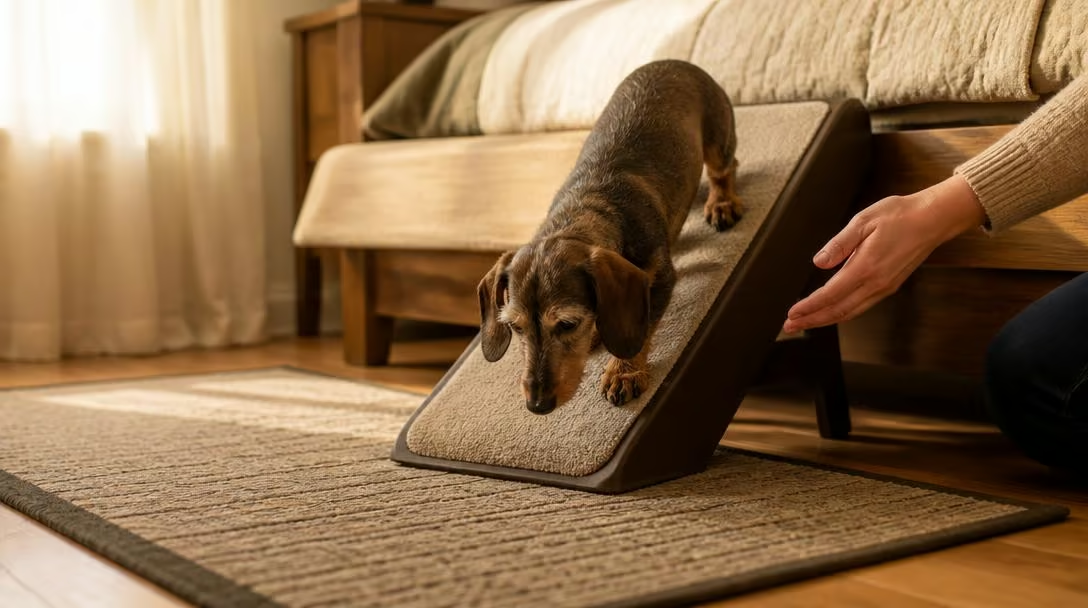
- Pair ramps and non-slip traction with the sensory changes in mind; our senior dachshund home safety guide covers this in more depth, and it becomes even more relevant once depth perception starts to slip.
It’s also worth knowing that sensory decline and early cognitive dysfunction can look similar from the outside — both can cause disorientation, changed sleep patterns, and reduced responsiveness. If your dachshund is showing signs beyond what’s described here, especially confusion in familiar spaces or changes in house-training, it’s worth reading our guide to canine cognitive dysfunction in dachshunds alongside this one, since the two often get tangled together and benefit from being assessed separately.
Frequently Asked Questions
Can a dachshund live a full, happy life after going blind or deaf?
Yes. Dogs rely heavily on scent and touch to begin with, so vision and hearing loss — especially when gradual — tend to be far less disruptive to a dog’s quality of life than owners initially fear. Consistency in the home environment and a bit of patience go a long way.
Is my dachshund ignoring me on purpose, or is it hearing loss?
Selective “deafness” in dogs is real, but genuine age-related hearing loss has a different pattern: it’s consistent regardless of how interesting the request is, it happens even when there’s no competing distraction, and it’s usually paired with not waking to loud ambient sounds like the doorbell. If you’re not sure, the simple sound-response check described above is a good first step before assuming it’s behavioral.
Are dachshunds more prone to eye problems than other breeds?
Yes, somewhat. The breed has documented rates of hereditary cataracts and progressive retinal atrophy above the average for dogs generally, which is part of why routine eye checks during senior wellness visits matter even if nothing seems obviously wrong yet.
Can cataracts be treated in a senior dachshund?
Surgical cataract removal is possible and often successful in dogs, including seniors, provided they’re otherwise healthy enough for anesthesia. It’s a decision to make with your vet or a veterinary ophthalmologist based on how much the cataracts are actually affecting your dog’s daily life, not age alone.
The Bottom Line
Vision and hearing changes are one of the quieter parts of getting older for a dachshund — there’s no single dramatic moment, just small shifts that add up. Catching those shifts early, getting a proper exam rather than guessing, and making a handful of practical adjustments at home are usually all it takes to keep a senior dachshund moving through the world with just as much confidence as ever, just relying on different senses to do it.


