
I get asked this one more than you’d expect: “Hank, is the Wienermobile basically a giant dachshund on wheels?” It usually comes up around the time the Oscar Mayer Wienermobile rolls through someone’s town, or shows up on their local news doing a parade lap. People see a hot-dog-shaped vehicle, remember that dachshunds get called “wiener dogs,” and assume the two must be the same joke wearing two different costumes. I used to assume the same thing, honestly, until I actually looked into it.
The short answer is no — the Wienermobile isn’t modeled on a dachshund at all. But the longer answer is a lot more interesting, and it says something real about why our breed ended up with a hot dog’s nickname in the first place. Let’s sort out the myth from the fact.
What the Wienermobile Is Actually Shaped Like
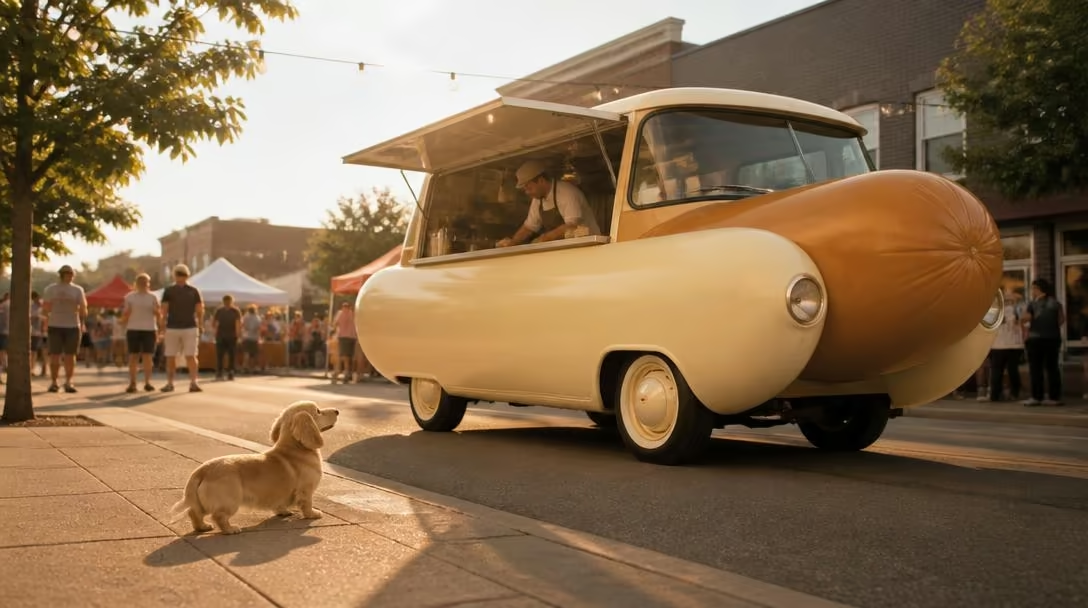
The Wienermobile is, and always has been, a hot dog in a bun on wheels — not a dog of any breed. Oscar Mayer’s nephew, Carl G. Mayer, built the first one in 1936: a 13-foot mobile hot dog meant to roll around Chicago handing out samples. There’s no dachshund silhouette in the design anywhere — no ears, no snout, no tail. Designer Brooks Stevens gave it its most recognizable fiberglass redesign in 1958, and by his own description, the whole concept was simply “putting the wiener in the bun.” That’s it. That’s the bit.
Today’s fleet of six Wienermobiles is built on modified van chassis, each one still following that same hot-dog-and-bun shape the company has stuck with for nearly ninety years. If you’ve ever squinted at one expecting to see long ears or a dachshund’s tapered snout, you were looking for something that was never actually there.
So Why Do People Assume It’s a Dachshund?
The confusion isn’t really about the vehicle’s shape — it’s about the word “wiener.” Dachshunds have been nicknamed “wiener dogs” and “sausage dogs” for so long, in so many countries, that a lot of people’s brains have quietly merged the two ideas: wiener-shaped car, wiener-nicknamed dog, must be the same thing. It’s an understandable leap. Both nicknames come from the exact same visual joke — a long, low, cylindrical shape that looks uncannily like a hot dog — they just got applied to two completely different objects decades apart, for the same reason.
That’s actually the more interesting story here. The Wienermobile didn’t inspire our breed’s nickname, and our breed didn’t inspire the Wienermobile. They’re two separate punchlines that both landed on the same joke, because a dachshund’s body really does look like a hot dog if you’re being honest about it, and so does a hot dog in a bun on wheels. Great minds — or at least, great marketing instincts and great evolutionary outcomes — occasionally think alike.
Where “Wiener Dog” Actually Comes From
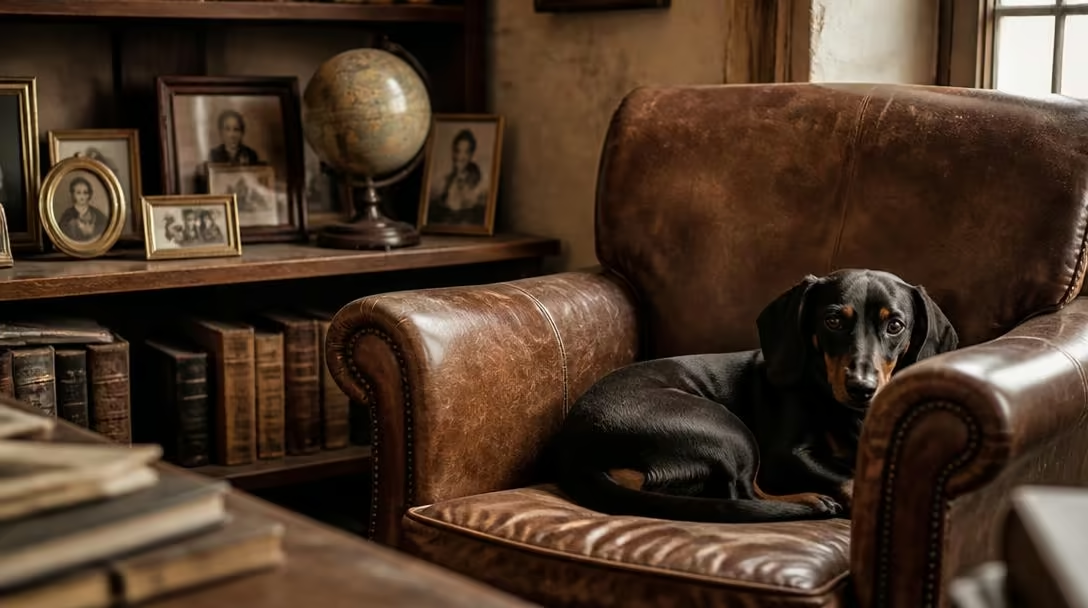
The dachshund’s hot-dog nicknames trace back to the breed’s German roots, not to any American advertising campaign. “Dachshund” itself is German for “badger dog” (Dachs meaning badger, Hund meaning dog), which tells you about the breed’s original job, not its shape. But once dachshunds became popular pets in English-speaking countries in the 1800s and early 1900s, English speakers latched onto the obvious visual joke instead of the German working-dog history: a long body on short legs looks a lot like a hot dog, or a sausage, so “wiener dog” and “sausage dog” stuck as affectionate nicknames, independent of anything happening at the Oscar Mayer company.
If you want the fuller version of how dachshunds went from working badger hunters to the breed we know today, I covered that history in more depth in my earlier piece on the dachshund’s origins — the nickname is really just the final, funniest chapter of a much older story.
The timing lines up in a telling way, too: “wiener dog” as a nickname for dachshunds was already in casual use well before Carl Mayer ever built his first mobile hot dog in 1936. The dog got there first. The car just happened to borrow the same joke later, for the same reason — because both of them are long, low, and shaped like lunch.
The Wienermobile’s Real History, in Brief
Since we’re already down this road, the Wienermobile’s own story is genuinely fun, and worth knowing if you’re the kind of dachshund owner who gets this question at parties. A few highlights:
- It started as a sampling tool, not a mascot. Carl Mayer’s 1936 original was built to hand out samples around Chicago — it wasn’t designed to be famous, it was designed to sell hot dogs.
- It went away, then came back. Interest faded in the 1960s and ’70s, and the vehicle was largely retired until Oscar Mayer brought it back for the company’s 50th anniversary in 1986, then ordered six new ones in 1988 on Chevrolet van chassis.
- The drivers have a job title, and it’s a real one. Each Wienermobile carries two recent college graduates called “Hotdoggers,” who spend a year driving the vehicle around the country, posting on social media, and handing out “whistle” giveaways at stops. Around 1,000 to 1,500 people apply for roughly a dozen spots each year.
- It has had a few genuinely wild moments. One was stolen in Seattle in 1973 and later recovered. A Virginia state trooper once redirected one away from the Pentagon. One flipped on a Chicago-area interstate in 2024 with no injuries. It’s had more adventures than most dogs, dachshund or otherwise.
- It briefly changed its name. In 2023, Oscar Mayer renamed it the “Frankmobile” for a few months to promote a new recipe, before switching the name back later that year.
None of that history involves a dachshund. It’s a genuinely separate story that happens to rhyme with ours because of one shared shape.
Why This Mix-Up Isn’t Really a Bad Thing
If you’re a dachshund owner, I’d actually argue this mix-up has done the breed a favor over the decades. Every time the Wienermobile rolls through a town and someone jokes “that thing looks like my dog,” it’s free, good-natured attention for a breed that already loves being the center of one. The nickname “wiener dog” has become genuinely affectionate rather than mocking — most owners I know (myself included) use it proudly, not reluctantly. It’s part of what makes the breed instantly recognizable and endlessly meme-able, in a way that’s mostly worked in our favor.
It’s also a nice reminder that dachshunds didn’t need a marketing campaign to earn their nickname. The shape did all the work on its own, over a century before anyone built a hot dog car to go with it — the same shape that’s turned into its own summer tradition at wiener dog races around the country, where owners lean into the joke on purpose.
Frequently Asked Questions
Is the Wienermobile modeled after a dachshund?
No. It’s modeled after a hot dog in a bun — designer Brooks Stevens described the concept simply as “putting the wiener in the bun.” There’s no dachshund in the design itself; the resemblance people notice is really just two things sharing the same long, cylindrical “hot dog” shape independently.
Did the Wienermobile come before or after dachshunds were called “wiener dogs”?
After. Dachshunds had already picked up nicknames like “wiener dog” and “sausage dog” in English-speaking countries well before Carl Mayer built the first Wienermobile in 1936. The nickname is older than the vehicle.
Why are dachshunds called wiener dogs in the first place?
It comes down to shape, not history. A dachshund’s long body and short legs looked enough like a sausage or hot dog that English speakers nicknamed the breed accordingly, separate from the German “badger dog” meaning behind the actual name “dachshund.”
Do Hotdoggers (the Wienermobile’s drivers) know about the dachshund connection?
There’s no official link for them to know about, since the vehicle isn’t dachshund-themed — but anecdotally, dachshund owners are some of the most enthusiastic people to flag down a Wienermobile when they spot one, which has become its own fun, informal tradition at Wienermobile stops around the country.
The Bottom Line
The Wienermobile and the dachshund’s “wiener dog” nickname are two different jokes that happen to share a punchline. One’s a near-ninety-year-old marketing vehicle shaped like a hot dog bun; the other is a breed whose body shape earned it the same nickname, decades earlier, with zero input from Oscar Mayer. They’re not related, but I understand exactly why everyone keeps asking — and if your dachshund gets extra stares the next time one rolls through your town, you can set the record straight while enjoying the free publicity.
If you enjoyed digging into the breed’s history here, you might also like the full story of how dachshunds evolved from working badger hunters into beloved companions — the real history is honestly just as fun as the sausage jokes.


