Every year around this time, my inbox fills up with the same kind of question: “Hank, is there anything different I should be doing now that summer’s over?” It’s a fair thing to wonder. We spend all spring and summer talking about heatstroke and hot pavement, and then fall shows up quietly and gets treated like a non-event — just a nicer temperature to walk in. But autumn actually brings its own list of hazards, and a handful of them matter more for a dachshund than they would for a longer-legged dog.
A dachshund’s whole build — long spine, short legs, nose close to the ground — means this breed experiences fall differently than most. They’re closer to the leaf piles, the fallen acorns, and the mushrooms popping up after the first cool rains. Their hunting instinct, bred into them generations ago to go after badgers and other burrowing animals, tends to spike as squirrels and other critters get busy stocking up for winter. And their back, already the single biggest health concern I talk about on this site, is more vulnerable on wet leaves and slick porch steps than most owners realize. So let’s walk through what actually changes in autumn and what to do about each one.
Why Fall Hits Dachshunds a Little Differently
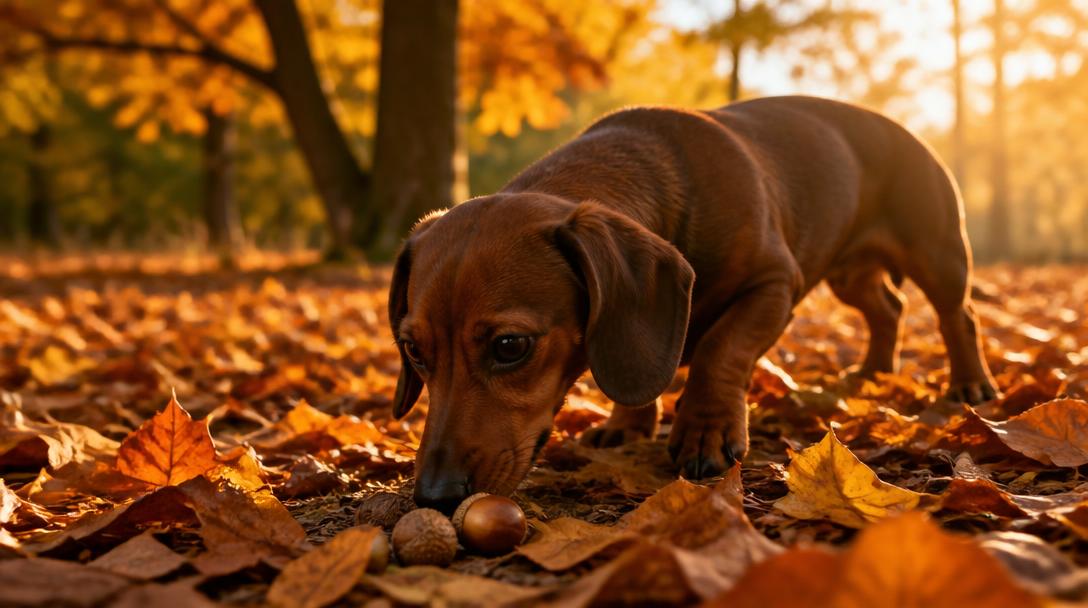
Picture a golden retriever and a dachshund walking through the same pile of leaves. The retriever’s nose is a couple feet off the ground; a dachshund’s is practically in the pile. That means dachshunds encounter — and often eat — whatever’s hiding underneath long before a taller dog would even notice it’s there. Wet, decomposing leaves are also a magnet for mold and can hide sharp debris, broken glass, or fallen branches that a low-slung dog’s chest and belly pass right over.
Then there’s the instinct piece. Dachshunds were bred to track and dig after badgers, and that same wiring makes fall’s uptick in squirrel and chipmunk activity genuinely exciting for them. A sudden lunge toward a squirrel bolting across the yard is exactly the kind of twisting, explosive movement that puts stress on a dachshund’s long back — which is why I want fall walks to be on a secure leash, not off-leash “just this once” moments, no matter how well-trained your dog usually is.
Hidden Hazards on the Ground: Acorns, Mushrooms, and Fallen Fruit
Fall lawns and sidewalks turn into a minefield of things a curious, ground-level nose finds irresistible. A few to watch for on your regular walking routes:
- Acorns and conkers — not toxic in small amounts, but they can cause an upset stomach, and a swallowed acorn is a real choking and intestinal blockage risk for a small dog. Dachshunds are enthusiastic chewers, so a mouthful of acorns is more common than you’d think.
- Wild mushrooms — cooler, damp fall weather is prime mushroom season, and some varieties that pop up in yards and along trails are genuinely toxic to dogs. If your dachshund grabs a mushroom on a walk and you can’t positively identify it as safe, treat it as an emergency and call your vet or an animal poison control line.
- Fallen fruit — apples, pears, and other fruit that drops and sits on the ground can start fermenting or growing mold within a day or two, and moldy fruit can cause tremors or other neurological symptoms in dogs. If you’ve got fruit trees nearby, a quick sweep of the yard before letting your dog out is worth the thirty seconds.
The general rule I give people: in fall, assume the ground itself is more interesting — and slightly more dangerous — to your dachshund than it was in July, and adjust your supervision accordingly.
Seasonal Allergies and the Coat Transition
If your dachshund seems itchier or sneezier in September and October, you’re not imagining it. Ragweed pollen peaks in early fall in most of North America, and mold spores from decomposing leaves add a second allergy trigger right on top of it. Watch for excessive scratching, paw-licking, red or watery eyes, or ear infections — all common signs of seasonal allergies in dogs, and all worth a vet visit if they’re new or getting worse, since allergy symptoms can sometimes overlap with skin infections that need their own treatment.
You’ll also likely notice more fur around the house this time of year. Dogs typically shed their lighter summer coat in fall to grow in a denser one for winter, and dachshunds — smooth, wirehaired, or longhaired — all go through some version of this transition. Regular brushing a few times a week does double duty here: it manages the shedding and gives you a chance to spot any skin irritation from allergies while you’re at it. If shedding seems unusually heavy or patchy rather than a normal seasonal changeover, it’s worth reading through our dachshund shedding guide to know what’s typical and what’s not.
Halloween Season: Candy, Costumes, and Décor
Halloween falls squarely in the middle of autumn, and it brings its own cluster of risks. Chocolate is toxic to dogs year-round, but Halloween is the one time a year it’s sitting in an unguarded bowl at nose height for a dog who will absolutely find a way onto the coffee table if left alone with it for five minutes. Sugar-free candies sweetened with xylitol are even more dangerous — xylitol can cause a rapid, life-threatening drop in blood sugar in dogs, and it takes a surprisingly small amount to do it. Keep the candy bowl somewhere your dachshund genuinely cannot reach, not just somewhere they usually don’t go.
A few other Halloween-specific things worth thinking about:
- Costumes — if you dress your dachshund up, make sure the costume doesn’t restrict movement, breathing, or vision, and do a trial run before the big night to make sure your dog isn’t stressed by it.
- Jack-o’-lanterns and candles — an open flame at tail height is a real burn and knock-over risk with a low, long dog wandering around.
- The front door — a night of the doorbell ringing constantly for trick-or-treaters is exactly the kind of scenario where an anxious or excited dog slips out an open door. Consider keeping your dachshund in a separate room during peak trick-or-treat hours, both for their stress level and for your own peace of mind.
Rodenticides and Antifreeze: Autumn’s Quiet Poisons
As temperatures drop, rodents start looking for warm places to hide, and a lot of households and neighbors respond by putting out rodenticide (rat and mouse poison) around garages, sheds, and property lines. These products are specifically designed to be appealing to animals, which unfortunately doesn’t stop at rodents — dachshunds are exactly the right size and ground-level build to investigate a bait station a taller dog might walk past. Fall is also when a lot of people top off or drain their car’s coolant system, and antifreeze has a sweet taste dogs find appealing despite being extremely toxic in small amounts. If you use either product, or suspect a neighbor does, keep your dachshund on leash and supervised in areas where they might be present, and know that both are true emergencies if ingested — don’t wait to see if symptoms develop before calling your vet.
Shorter Days Mean Rethinking Walk Timing
By late fall, a lot of us end up walking the dog before work or after dinner in near-darkness. A dachshund’s low profile already makes them harder for drivers and cyclists to spot than a larger dog, so a reflective harness or leash, a clip-on light, and sticking to well-lit, familiar routes all become more important as daylight shrinks. It’s a small habit change, but it’s one of the easiest ways to reduce risk without changing anything about your actual walking routine.

Temperature Swings and Your Dachshund’s Back
Fall weather doesn’t just mean cooler days — it means wildly variable ones, with warm afternoons giving way to cold, damp evenings, sometimes within the same day. Cooler, damp conditions can make older dachshunds or ones with existing joint or back issues feel stiffer, and that stiffness itself can be a contributing factor to a bad landing off a step or a couch. Combine that with wet leaves covering porch steps, decking, and grass — all slippery surfaces a dachshund’s short legs have to navigate carefully — and you’ve got a season where back safety deserves a little extra attention.
The core rules don’t change from any other time of year: no unsupported jumping on or off furniture, use ramps or steps for the car and the couch, and keep an eye out for any hesitation, yelping, or reluctance to move that could signal a back problem developing. If you haven’t already, our full guide to dachshund spinal health and IVDD prevention is worth a read before the wetter, colder months really set in — a lot of what protects a dachshund’s back in fall is exactly what protects it in winter too.
A Quick Fall Safety Checklist
- Keep walks on-leash, especially in areas with heavy wildlife activity or leaf cover
- Do a quick yard sweep for fallen fruit, mushrooms, and acorns before letting your dog out
- Watch for new scratching, sneezing, or eye irritation as signs of seasonal allergies
- Store Halloween candy well out of reach, and know the signs of chocolate or xylitol poisoning
- Ask neighbors about rodenticide or antifreeze use nearby and keep your dog away from those areas
- Add reflective gear for walks as daylight hours shrink
- Use ramps or steps and watch for stiffness as temperatures start swinging
Frequently Asked Questions
Are fallen leaves themselves dangerous to dachshunds?
Dry leaves generally aren’t a problem, but wet, decomposing leaf piles can harbor mold and hide sharp debris or other hazards underneath. It’s less about the leaves and more about what’s buried in them.
How do I know if my dachshund has seasonal allergies versus a skin infection?
Both can look similar — itching, redness, licking — so the honest answer is that a vet visit is the only reliable way to tell. If symptoms are new, worsening, or accompanied by hair loss or odor, don’t wait it out.
Is it safe to dress my dachshund up for Halloween?
Yes, as long as the costume doesn’t restrict breathing, vision, or leg movement, and your dog isn’t showing signs of stress wearing it. Do a short trial run at home first.
My dachshund ate an acorn — should I worry?
One small acorn usually just means a possible upset stomach, but if your dog is having repeated diarrhea, vomiting, straining, or seems lethargic, call your vet — a swallowed acorn can occasionally cause a blockage in a small dog.
Do dachshunds need a jacket for cool fall weather?
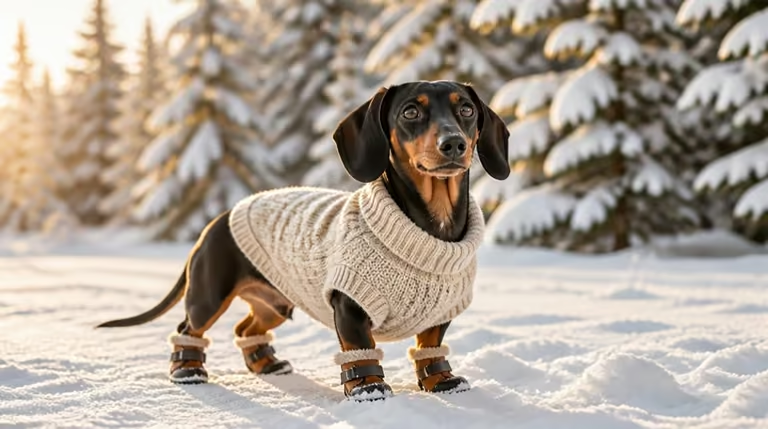
Smooth-coated dachshunds especially can benefit from a light jacket once temperatures consistently drop into the 50s Fahrenheit, since they don’t carry much body fat or a heavy undercoat for insulation. Wirehaired and longhaired dachshunds generally handle cool fall weather a bit better on their own.
Enjoy the Season, Just Keep an Eye Out
None of this is meant to make fall sound like a season to dread — it’s genuinely one of the best times of year for a walk with your dachshund, with cooler temperatures and none of the summer heatstroke risk we talk about so much. It just pays to know what’s different: what’s hiding in the leaves, what’s sitting in the candy bowl, and what your dog’s back needs as the ground gets wetter and the days get shorter. A little extra awareness now sets you up well for the snow and ice conversations we’ll be having again before you know it.