
If you’ve ever watched your dachshund disappear nose-first into a pile of leaves or wedge themselves under a hedge chasing a scent, you already know this breed doesn’t do things halfway. That same badger-hunting drive that makes them so much fun to watch also puts them squarely in the path of two of the most common (and preventable) health problems a dog owner deals with: fleas and ticks. Because a dachshund’s body sits so low to the ground, they brush up against the exact places fleas and ticks wait — tall grass, leaf litter, brush, and the undersides of shrubs — far more than a dog standing a foot and a half off the ground ever will.
The good news is that flea and tick prevention for dachshunds isn’t complicated once you understand what to look for and which products actually make sense for this breed’s size, coat, and health profile. This guide walks through why dachshunds are especially exposed, how to recognize an infestation early, how to choose a safe preventive, and what to do about your yard and home so the problem doesn’t keep coming back.
Why Dachshunds Are Especially Prone to Fleas and Ticks
A dachshund’s body shape isn’t just an aesthetic quirk — it’s a direct line to the environments where fleas and ticks live. Standing only a few inches off the ground, a dachshund’s belly, chest, and legs make constant contact with grass, mulch, and undergrowth that a taller breed would simply walk over. Add in the breed’s instinct to dig, burrow, and track scents nose-down (a holdover from their original job hunting badgers and other burrowing game), and you’ve got a dog that’s practically designed to pick up hitchhikers on every walk.

This instinct runs deep enough that it shapes a lot of dachshund behavior beyond just bug exposure — if you want the fuller picture of why they’re wired this way, it’s worth reading through our guide to understanding sausage dog behavior. For flea and tick purposes, the practical takeaway is simple: any time your dachshund is in grass, woods, or brush — even your own backyard — treat it as exposure time, not just exercise time.
Recognizing the Signs of Fleas and Ticks on a Dachshund
Catching an infestation early makes it dramatically easier to treat and far less uncomfortable for your dog. Fleas tend to show up first in areas with thinner fur and easy access to skin — the belly, the inner hind legs, the armpits, and around the base of the tail. Run a flea comb through those areas and look for small dark specks. If you wet a paper towel and rub those specks onto it and they turn reddish-brown, that’s “flea dirt” (digested blood), and it’s one of the most reliable early signs of an infestation, often showing up before you ever see an actual flea.
Ticks are easier to see once attached but harder to spot on a long-haired or wirehaired dachshund, since they can bury themselves close to the skin under a thick coat. After any walk through grass, brush, or wooded trails, run your hands slowly over your dog’s whole body, paying particular attention to the ears, between the toes, around the collar, the armpits, and the groin — ticks favor warm, hidden spots.
One dachshund-specific concern worth flagging: flea allergy dermatitis causes intense itching, and a dog that’s constantly twisting, scratching, and biting at their lower back and hips to relieve that itch is putting repeated strain on a spine that’s already more vulnerable to disc problems than most breeds. If you’re managing a dachshund with any history of back issues, a flea problem isn’t just an itch — it’s a reason to be extra cautious. Our guide on safe exercise for dachshunds with back problems covers more on protecting that vulnerable spine day to day.
Choosing the Right Prevention Product for Your Dachshund
There’s no single “best” flea and tick product for every dachshund — the right choice depends on your dog’s weight, age, health history, and how much outdoor exposure they get. Broadly, preventives fall into a few categories:
- Oral chewables (once-monthly tablets) are convenient and don’t wash off during swimming or bathing, but they require your dog to actually eat them and work systemically once ingested.
- Topical spot-on treatments are applied to the skin, usually between the shoulder blades, and work through the skin’s oil layer. They’re a solid option for dogs that are picky eaters, but they need a dry period after application and can be affected by frequent bathing.
- Collars offer longer-lasting, continuous protection and can be convenient for multi-dog households, but fit matters — a collar that’s too loose on a dachshund’s compact neck won’t maintain skin contact.
Because dachshunds range so widely in size — a standard can weigh two to three times what a miniature does — dosing by weight matters more here than it might for a more size-consistent breed. Always weigh your dog and confirm the product is labeled for their specific weight range rather than estimating. If you’re unsure which size category your dog falls into, our guide to the miniature dachshund breaks down how the size varieties differ.
Safety Considerations: What to Watch For
Most dogs tolerate veterinarian-approved flea and tick preventives without any issue, but it’s worth knowing what to watch for. The FDA has issued safety communications noting that a class of oral preventives called isoxazolines (the active ingredient in several popular chewable brands) has been associated with neurological side effects in a small number of dogs, including muscle tremors, incoordination, and seizures. These reactions are uncommon, and the FDA’s communication was a precaution rather than a recall, but it’s a legitimate reason to have a real conversation with your veterinarian — especially if your dachshund has a personal or breed-related history of neurological issues, is a senior, or is already on other medications.
A few practical habits apply no matter which product you choose:
- Never use a product labeled for cats on a dog, or vice versa — some cat-specific ingredients are toxic to dogs and the reverse is also true.
- Always confirm your dog’s current weight before dosing; weight-banded products are not interchangeable across bands.
- If you’re switching products or using more than one type of prevention, ask your vet whether they’re safe to combine — some combinations are fine, others overlap in ways that increase side-effect risk.
- Watch your dog for the first 24 hours after starting any new product, and call your vet promptly if you notice vomiting, lethargy, tremors, or unusual behavior.
Senior dachshunds deserve a bit of extra caution here, since age-related liver or kidney changes can affect how a dog processes any medication. If you’re caring for an older dog, it’s worth reading our senior dachshund care guide alongside whatever your vet recommends for parasite prevention.
Tick Checks and Removal Done Right
Make a tick check part of your routine after every walk through grass, woods, or brush — not just an occasional glance. Run your hands slowly over your dog’s entire body, feeling for small bumps rather than relying on sight alone, since an attached tick can be easy to miss by eye on a wirehaired or long-haired coat. Pay close attention to the ears (inside and out), between the toes, the armpits, the groin, and around the collar and tail base.
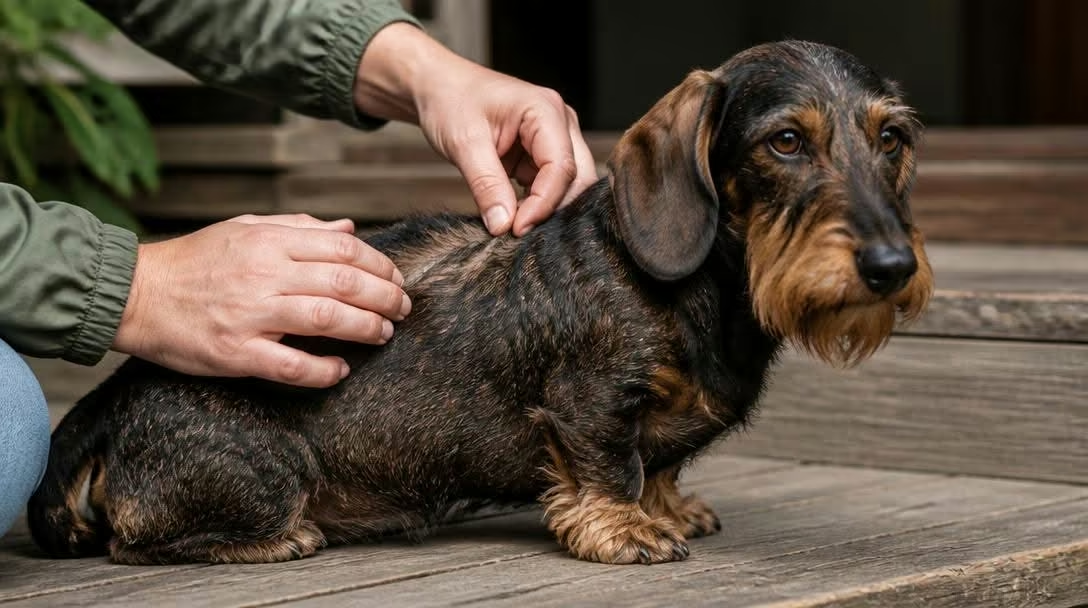
If you find a tick already attached, don’t panic and don’t twist or yank it. Use fine-point tweezers or a dedicated tick-removal tool, grasp the tick as close to the skin as possible (by the head, not the body), and pull straight out with slow, steady pressure. Avoid squeezing the body, which can push infectious material back into the bite site. Clean the area afterward with soap and water, and keep an eye on the spot for the next few weeks for any redness or swelling that doesn’t heal normally. If you’re ever unsure whether you removed the whole tick, or your dog seems unwell in the days that follow, call your vet.
Wirehaired dachshunds in particular benefit from a quick comb-through after outdoor time, since their dense, wiry coat is excellent at hiding both fleas and ticks. If grooming maintenance is already part of your routine, our wirehaired dachshund grooming guide is a natural companion to a regular tick-check habit.
Protecting Your Yard and Home
Prevention works best when it isn’t just about the dog — the environment matters too. Keep grass mowed short and clear away leaf litter, brush piles, and tall weeds, especially along fence lines and shaded areas where ticks tend to wait for a host. If fleas have already made it indoors, wash all pet bedding in hot water and dry it on a high heat setting, vacuum carpets and furniture thoroughly (including under cushions), and empty the vacuum canister outside right away so eggs and larvae don’t just end up back in the house.
For an infestation that isn’t responding to routine cleaning and preventive products, a professional pest control treatment for the yard or home may be necessary. If you go this route, remove pets and people from treated areas for the length of time the label specifies, and confirm whatever’s used is labeled safe for dogs.
Seasonal Considerations
In much of North America, flea and tick season peaks from spring through fall, but that doesn’t mean winter is a safe window to skip prevention entirely. Fleas can survive indoors year-round regardless of outdoor temperature, and in milder climates, ticks can remain active any time the temperature stays above freezing for more than a day or two. The safest approach for most dachshund owners is year-round prevention rather than a seasonal on-and-off schedule — talk to your vet about whether your specific region and your dog’s lifestyle call for a true 12-month plan or a more targeted seasonal one.
Frequently Asked Questions
How often should I check my dachshund for fleas and ticks?
Ideally, do a quick check after every outdoor walk in grass, woods, or brush, plus a more thorough weekly check even during quieter weeks. Dachshunds’ low-to-the-ground build means exposure can happen even on short walks around the block.
Are natural flea and tick remedies safe for dachshunds?
Some natural approaches, like essential-oil sprays or diatomaceous earth for the yard, can help as a supplement to a prevention routine, but they’re generally less reliably effective than veterinarian-approved products, especially once an infestation has already started. Talk to your vet before relying on natural methods alone, and always check that any essential oil used is actually dog-safe, since several common ones are toxic to dogs in concentrated form.
Can fleas or ticks make my dachshund’s back problems worse?
Indirectly, yes. The intense itching from flea allergy dermatitis can cause a dog to twist, scratch, and bite at their lower back and hips repeatedly, which adds strain to a spine that’s already more prone to disc issues in this breed. Keeping fleas under control is one more piece of protecting your dachshund’s back long-term.
What’s the difference between a tick preventive and a flea preventive?
Many modern products protect against both in a single formulation, but not all do — some are flea-only. Always check the product label or ask your vet to confirm it covers both parasites if that’s what you need, rather than assuming.
My dachshund is a senior with health issues — are flea and tick products still safe?
In most cases, yes, but it’s worth a direct conversation with your vet about your dog’s specific health history before starting or switching products. Age-related changes in organ function can affect how a dog processes certain medications, so a preventive that was fine for your dog at five may need a second look at twelve.
The Bottom Line
Fleas and ticks are one of the few health risks that are almost entirely preventable with a consistent routine: the right product for your dog’s size and health profile, regular checks after outdoor time, and a yard and home environment that doesn’t give parasites a place to thrive. Given how much time dachshunds spend nose-down in exactly the places fleas and ticks wait, a little extra vigilance here goes a long way toward keeping your dog comfortable and healthy year-round. When in doubt about which product or schedule makes sense, your veterinarian remains the best resource — they know your dog’s full health history in a way no article can.


