
If you’ve ever been towed down the sidewalk by twenty-five pounds of determination packed into an eleven-pound dog, you already know what I’m talking about. As Simply Dachshund’s Training Expert, leash pulling is one of the most common questions I get from owners, and it catches a lot of people off guard. Dachshunds aren’t a big breed, but they pull like one — and once you understand why, the fix is a lot more straightforward than most owners expect.
This guide covers why dachshunds pull so hard in the first place, why your choice of equipment matters more for this breed than almost any other, and a step-by-step training method that works whether you’re starting with a brand-new puppy or trying to retrain an adult dog who’s been dragging you around for years.
Why Dachshunds Pull So Hard on the Leash
Pulling isn’t stubbornness for its own sake, even though it can feel that way at 7 a.m. on a cold morning. Dachshunds were bred to hunt badgers independently underground, which means their working history selected hard for a dog who follows its nose, commits fully to a scent trail, and doesn’t quit or look back to check in with a handler once it’s locked onto something interesting. That same drive shows up on a casual neighborhood walk as a dog hitting the end of the leash at full speed the moment an interesting smell crosses the path.
Add in their famously independent streak — dachshunds were never bred to take constant direction the way a herding or retrieving breed was — and you get a dog that’s intelligent enough to learn loose-leash walking quickly, but not naturally inclined to offer it for free. The pulling is a breed trait, not a training failure on your part, and it responds very well to a structured plan.
Why the Right Equipment Matters More Than Almost Any Other Breed
Before you touch training mechanics at all, equipment needs to come first for this breed specifically. Dachshunds have an unusually long back and a build that makes them prone to intervertebral disc disease, and every hard lunge against a collar sends that jolt through the neck and spine rather than spreading it across the body the way it would on a longer-legged, more proportionally built dog. A dog who pulls hard on a collar day after day is adding repeated strain to exactly the part of their body you most need to protect.
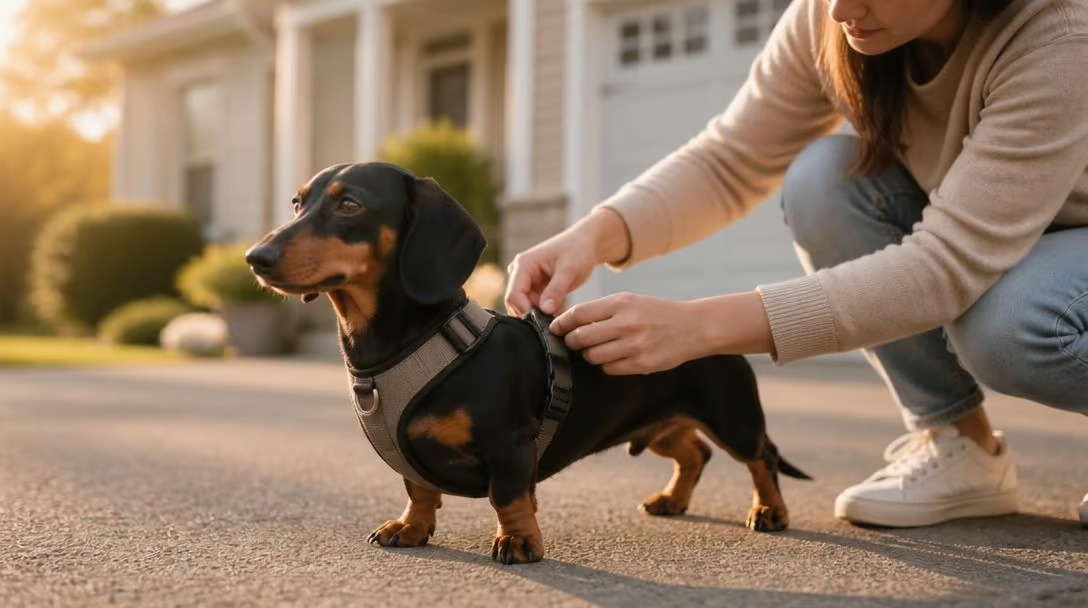
A properly fitted harness is non-negotiable here, not a nice-to-have. It moves the pressure of a pull onto the chest and shoulders instead of the throat and neck, and it gives you a much safer point of control if you ever need to stop sudden forward motion — toward a squirrel, another dog, or a patch of tempting garbage. If you haven’t settled on a harness yet, our harness buying guide walks through what to look for in fit and style for this body type, and it’s worth sorting out before you start any of the training below.
A front-clip harness is usually the better starting point for a dog who’s actively pulling, since it gently turns the dog back toward you rather than letting them drive forward into the pull with their full chest, the way a back-clip design allows. You can graduate to a back-clip harness for everyday wear once loose-leash walking is more reliable. Whatever you choose, retractable leashes work against you here — they reward pulling by design, since the leash only extends when there’s tension on it, so a standard four-to-six-foot leash is what you want for actual training sessions.
The Loose-Leash Method That Actually Works for Dachshunds
The method I recommend most is often called “be a tree,” and it works because it’s simple enough to apply consistently, which matters more than any clever trick. The moment the leash goes tight, you stop moving completely — feet planted, no talking, no pulling back. You wait. The instant there’s slack in the leash again, even if your dog just paused to look back at you in confusion, you mark that with a cheerful “yes” and take a step forward. If the leash tightens again, you stop again. Every single time.
This feels painfully slow for the first few sessions, and that’s normal. Dachshunds are smart enough to connect “leash goes tight, walk stops” within a handful of repetitions, but they need those repetitions to happen every time, not just when you’re feeling patient. Inconsistency is the single biggest reason this method fails — if pulling gets your dog to the lamppost three times out of five, you’ve taught them that pulling sometimes works, and sometimes-works is enough to keep a determined dachshund trying.
Layer in frequent rewards for checking in with you voluntarily. Keep small, high-value treats in a pocket and mark and reward any moment your dog glances up at you or walks a few steps with slack in the leash, even if you didn’t ask for it. You’re building a habit of paying attention to you as the more rewarding option compared to charging ahead. A change-of-direction drill helps too: periodically turn and walk the opposite way without warning, so your dog learns that watching where you’re going matters, rather than assuming the walk is always a straight line toward whatever’s ahead.
Keep early sessions short. Five to ten minutes of focused, serious training in your driveway or a quiet stretch of sidewalk will get you further than a full, distraction-heavy walk around the block, especially while your dog is still building the habit. Dachshunds have a shorter attention span for repetitive drills than some breeds, so a few short, successful sessions a day beat one long, frustrating one.
Puppy vs. Adult Dachshund: Adjusting Your Approach
If you’re starting with a puppy, you have a real advantage: there’s no established pulling habit to undo yet, just a young dog who hasn’t learned any leash manners at all. Keep early leash walks short, low-pressure, and reward-heavy, and most puppies pick up loose-leash basics within a few weeks of short daily sessions.
Retraining an adult dog who’s been pulling for years is absolutely possible, but expect it to take longer and require more consistency from everyone in the household. An adult dog has had thousands of repetitions reinforcing that pulling gets them where they want to go, so the same number of repetitions teaching the opposite lesson simply takes more time. Rescue dachshunds in particular may also be adjusting to a new home and routine at the same time, so keep early sessions extra short and judge progress in small, steady improvements rather than expecting a fast turnaround.
Common Mistakes That Make Pulling Worse
A few habits quietly undo otherwise good training, and they’re worth watching for in yourself as much as in your dog.
- Jerking or yanking the leash as a correction. Beyond the back and neck strain risk already discussed, a hard correction teaches a dog to brace against tension rather than respond to it, which actually makes pulling worse over time.
- Letting the rules change depending on who’s holding the leash. If one household member allows pulling toward interesting smells and another enforces “be a tree” strictly, your dog learns the rule depends on the handler, not the leash.
- Using a retractable leash during active training. It directly rewards pulling by extending the length of travel whenever there’s tension, which works against everything you’re trying to teach.
- Skipping the equipment step. Training mechanics matter, but a poorly fitted harness or a collar on a committed puller undermines the method and adds physical risk on top of it.
- Only practicing on exciting walks. If every leash session happens in a high-distraction environment, you’re asking your dog to learn a new skill under the hardest possible conditions. Start in your yard or a quiet hallway before testing it on a busy street.
Troubleshooting Specific Pulling Triggers
Most dachshund pulling clusters around a few predictable triggers, and each one responds a little differently.
Scent trails and small animals
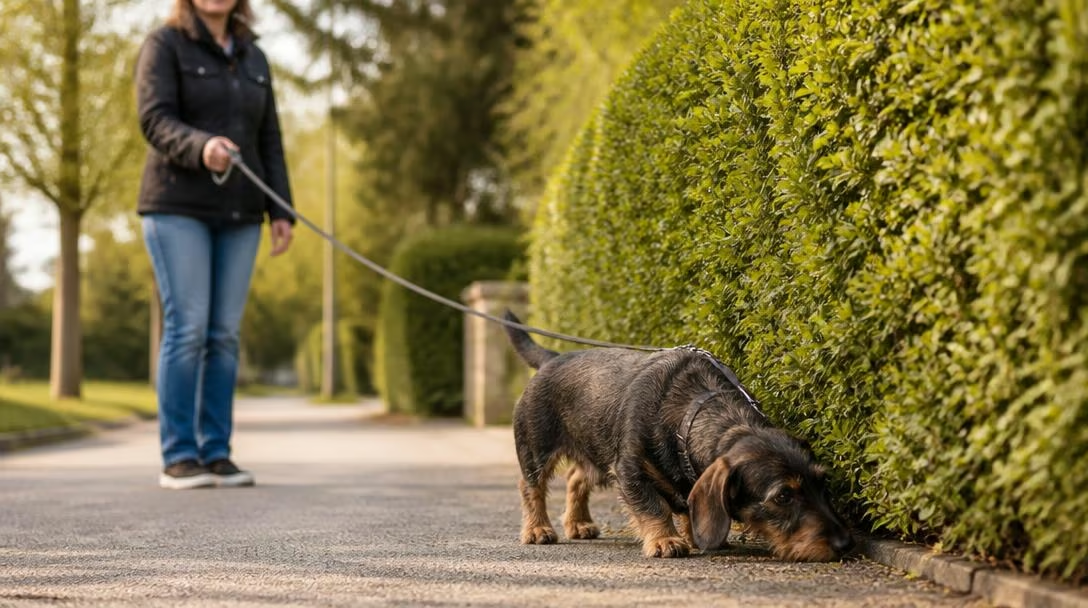
This is the hardest one to override completely, because it taps directly into the instinct that created the breed. Rather than fighting it outright, build in scheduled “sniff breaks” on a loose leash where your dog is allowed to investigate freely, so the rest of the walk isn’t a constant battle between their nose and your training goals. Knowing a sniff break is coming makes it easier for a dog to accept structure the rest of the time.
When a squirrel or rabbit suddenly appears, the “be a tree” rule still applies, but add distance as a tool too — if you can see a trigger coming, create space before the leash goes tight rather than waiting for the lunge to happen and then managing it.
Other dogs and leash reactivity
Pulling toward (or away from) other dogs is often as much about arousal or anxiety as it is about simple excitement, and it benefits from the same structure as general pulling, with added distance as your main management tool while you work on it. If pulling toward other dogs comes with barking, stiffening, or lunging rather than just excited tugging, that crosses into reactivity territory and may need a more targeted plan than general leash manners alone.
Doorways and the start of the walk
A lot of dachshunds do their hardest pulling in the first thirty seconds, right out the door, before they’ve settled into the walk at all. Build a brief “sit and wait” at the door into your routine before you clip the leash, so the walk itself doesn’t start on a burst of unmanaged excitement.
Frequently Asked Questions
How long does it take to leash train a dachshund?
Most puppies show solid improvement within two to four weeks of short, consistent daily sessions. Adult dogs retraining an established pulling habit often need six to eight weeks or longer, with progress measured in gradually looser leashes rather than an overnight fix.
Is a harness or a collar better for a dachshund?
A well-fitted harness is strongly recommended over a collar for everyday walking and training, given how much strain repeated pulling against a collar puts on a dachshund’s neck and long back. A properly sized collar still has a place for holding ID tags, but it shouldn’t be the point of leash attachment for a dog still learning not to pull.
My dachshund is already an adult and has pulled hard for years — can this still be fixed?
Yes. It takes longer and more consistency than starting with a puppy, but adult dachshunds retrain successfully all the time. The method doesn’t change, just your patience with the timeline.
Should I use a front-clip or back-clip harness?
Front-clip harnesses generally give you more control over an actively pulling dog, since they redirect the dog back toward you rather than letting them drive forward into the pull. Many owners switch to a back-clip harness for daily comfort once loose-leash walking is reliable.
My dachshund sometimes just stops and refuses to walk at all — is that related to leash training?
It can be, but it’s also common in dachshunds for other reasons, including discomfort, anxiety about a specific location, or simple stubbornness about which direction they’d rather go. If sudden stopping is new, frequent, or paired with signs of pain, it’s worth a vet check before assuming it’s purely a training issue.
Building a Walk You Both Actually Enjoy
Leash pulling in dachshunds comes from real breed instinct, not bad behavior, and that’s actually good news — it means the fix is consistent training and the right equipment, not a battle of wills you’re destined to lose. Commit to short, frequent sessions, stay consistent across everyone who walks your dog, and protect that long back with a proper harness from day one. Most owners see a real difference within a few weeks, and a loose leash makes every walk afterward a lot more pleasant for both of you.


